
The Godavari Pushkaralu 2027 runs from 26 June to 7 July 2027 — squarely in the opening weeks of the southwest monsoon over Andhra Pradesh. That timing is fixed by Jupiter, not by convenience, and it means the single biggest safety variable of the whole festival is the river itself. A Godavari in spate looks calm from the steps of a ghat and is nothing of the sort.
This guide covers what a monsoon spate actually does to the river, why boat services get suspended and why you should be glad they do, and the simple rules that keep a holy dip holy rather than dangerous. It is written by an independent pilgrim guide; every arrangement described here is run by the government, and every volatile detail links to an official source rather than being repeated as a fixed fact.
Monsoon and the Pushkaralu: safety at a glance
- Festival window: 26 June – 7 July 2027 — the monsoon’s opening weeks on the Godavari. See the dates and muhurtham guide.
- The river can rise fast. Upstream rain in Maharashtra and Telangana reaches Rajahmundry as a surge days later, even when local weather is dry.
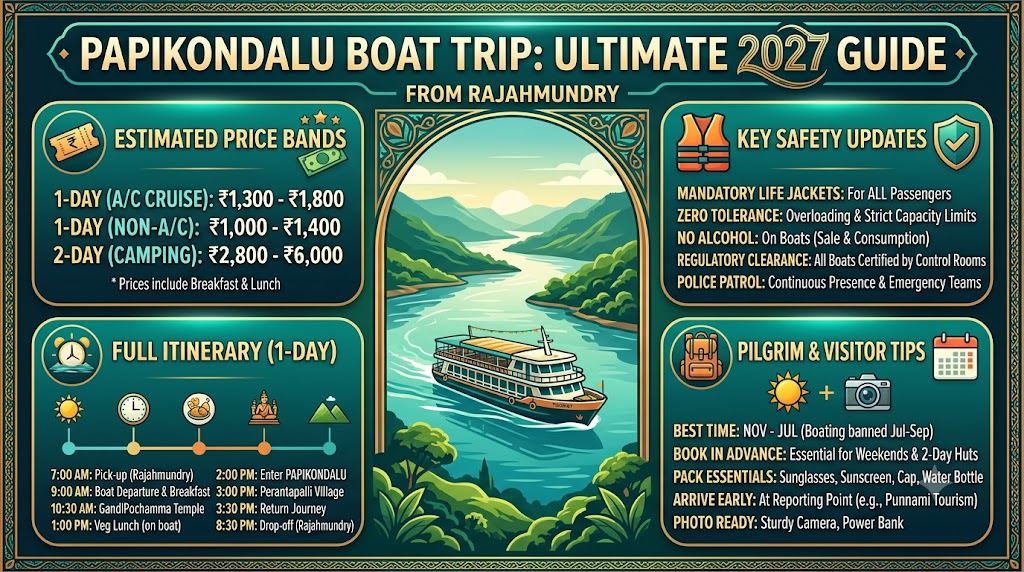
- Boat suspensions are normal. Authorities halt Papikondalu and other boat services whenever the river rises or a safety audit is due. A halted service is a working safety system, not a broken holiday.
- Bathe only at staffed, barricaded ghats. Never past the safety chains, never at unmanned stretches, never at night.
- Emergency numbers: 112 (all emergencies) and 108 (ambulance) work across Andhra Pradesh and Telangana.
What a river in spate actually means
Spate is the short word for a river carrying flood water. During the monsoon the Godavari at Rajahmundry can carry several lakh cusecs — hundreds of thousands of cubic feet of water passing every second. Three things change when that happens, and none of them are visible from the bank.
First, the current strengthens well below the surface, so water that looks slow on top pulls hard at waist depth. Second, the riverbed shifts: a sandbank that held your weight last week may be a scoured hole this week. Third, debris — whole trees, timber, wreckage — travels submerged at the speed of the current.
This is why the safe-bathing rules at Pushkaralu ghats are not bureaucratic decoration. The barricades and chains mark the line where officials have checked the depth and the current for that day’s water level. On the other side of the chain, nobody has.
The lesson of Kachhuluru, 2019
On 15 September 2019, the tourist boat Royal Vasishta capsized near Kachhuluru village on its way to Papikondalu, with 77 people aboard. Forty-six were confirmed dead. The river was in spate — over five lakh cusecs — and tour boats had been officially barred from the route because of the flooding. The boat went anyway.
That is the whole lesson in one sentence: the ban was right, and the decision to ignore it killed people. If you arrive during Pushkaralu and find boat services suspended, the system that frustrated your plans is the same one that would have saved 46 lives at Kachhuluru had it been obeyed.
Boat services get suspended — check before you plan
Suspensions are not rare events. In June 2026 the Rampachodavaram revenue office suspended all Papikondalu boat operations for a safety audit after a tourist boat developed a snag mid-river; services resumed only after about eighteen days, once a five-department committee had inspected the boats. Weeks later, in early August 2026, the Water Resources Department halted the tours again as flood levels rose at Devipatnam — with resumption only after the river stabilised and a fresh safety assessment.
Expect the same rhythm during Pushkaralu 2027. The festival weeks sit at the start of the monsoon, so a mid-festival suspension of boat rides is entirely possible. Treat any boat trip — Papikondalu cruises especially — as a plan that the river can veto on the day.
Before travelling, check the current position on the East Godavari district Pushkaralu page and with AP Tourism. Never board a private boat that is operating while official services are halted — that is precisely the Kachhuluru pattern.
Safe snanam when the river is high
The holy dip itself is safe when it is done where and how the arrangements intend. The rules below are the same ones announced at every recent Pushkaram, and they cost nothing:
- Use designated ghats only. The Rajahmundry ghats and the other Pushkaralu bathing locations are staffed with police, swimmers and medical posts during the festival. Quiet unmanned stretches upstream are where drownings happen.
- Stay inside the chains and barricades. They mark checked depth for that day’s water level, and the line moves as the river rises.
- Hold children by the wrist, not the hand, and keep non-swimmers to knee depth. Wet stone steps plus a crowd is the most common minor-injury combination at any Pushkaram.
- Bathe in daylight. Early-morning muhurtham crowds are dense but supervised; the river after dark is neither. The snanam timing guide covers the auspicious windows.
- Skip the dip if officials say so. On high-flood days authorities sometimes restrict bathing to sprinkling from the steps. A sankalpam and a sprinkle in obedience to the arrangements carries the merit; the scriptures nowhere demand that you defy a flood.
If the river rises mid-festival
A rising Godavari during the festival is likely, not exceptional — it is the monsoon. If it happens: follow announcements at the ghat, move to higher steps when asked, and expect boat rides, some ghats, or evening bathing to close at short notice. Ghat closures at one location usually leave others open; the locations guide lists alternatives along both banks.
Families with elderly pilgrims or small children should build one spare day into the itinerary. The most common way a flood spoils a pilgrimage is not danger — it is a fixed one-day plan meeting a river that needed you to wait until morning.
Emergency contacts and where help is
Dial 112 for any emergency and 108 for an ambulance anywhere in Andhra Pradesh and Telangana. During the festival, government helpdesks, medical camps and lost-and-found posts operate at the major ghats — our helpdesk guide explains what assistance is available and how to find it. Festival-specific helpline numbers are published by the district administration closer to the event; check the official district page rather than trusting numbers repeated on unofficial sites, including this one.
Before you go
The Godavari in monsoon deserves the same respect pilgrims already give it in worship. Plan the dip at a designated ghat, treat boat suspensions as protection rather than obstruction, keep one flexible day, and let the officials on the steps make the depth decisions. The river has carried this festival for centuries of monsoons — the arrangements exist so that it carries you home too.

Godavari Pushkaralu Editorial is the team that researches, writes and maintains this site.
godavaripushkaralu.org.in is an independent pilgrim guide. It is not affiliated with, endorsed by, or the official website of any government body or temple administration, and it takes no bookings or payments.
How we work: festival dates come from the Andhra Pradesh government notification and the East Godavari district portal rather than from other guides. Jupiter’s transits, which set the twelve-year Pushkaram cycle, are checked against published panchangam transit tables. Claims about government arrangements — ghats, medical camps, transport, helpdesks — are attributed to their source or clearly marked as plans, because for a festival still months away most of them are plans. Volatile details such as fees and muhurtham clock times link out to the official portal instead of being fixed in our pages.
Every page here is re-checked on a fixed schedule and corrected when the facts move. If you find an error, tell us through the contact page and we will fix it.