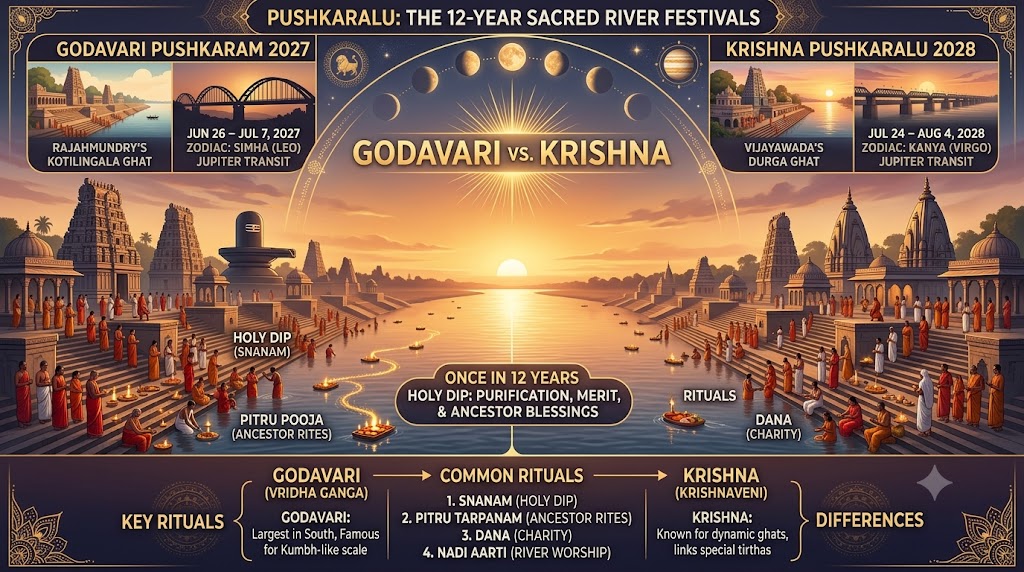
Compare Godavari vs Krishna Pushkaralu in detail — dates, sacred ghats, rituals and crowd sizes — so you can plan both once-in-12-years river festivals well.
The Godavari vs Krishna Pushkaralu question matters to every Telugu family right now, because both festivals arrive back to back. The Godavari Pushkaralu runs in 2027. The Krishna Pushkaralu follows in 2028. Two holy dips, two rivers, one rare chance in twelve years. This guide compares the dates, ghats, rituals and crowds clearly. It also corrects two date errors spreading online.
Quick Summary: Key Points at a Glance
- Godavari Pushkaralu 2027: June 26 to July 7, 2027 (official AP government dates).
- Krishna Pushkaralu 2028: Expected from late July 2028; dates not yet officially announced.
- Trigger: Jupiter in Simha (Leo) for Godavari; Jupiter in Kanya (Virgo) for Krishna.
- Main hubs: Rajamahendravaram for Godavari; Vijayawada for Krishna.
- Rituals: Identical in form — Pushkara Snanam, Pitru Tarpanam, Pinda Pradanam and dana.
- Expected crowd: Up to 10 crore devotees for Godavari 2027.
- Bonus: You can realistically attend both festivals in consecutive years.
What Is a Pushkaram?
A Pushkaram is a twelve-day river festival held once every twelve years for each of India’s twelve sacred rivers. Devotees believe Pushkara, a divine being blessed by Lord Brahma, enters a river when Jupiter enters its linked zodiac sign. A holy dip during these twelve days is believed to cleanse sins and honour ancestors.
Accordingly, each river takes its turn as Jupiter moves through the zodiac. The Yamuna had its Pushkaralu in June 2026. Next comes the Godavari in 2027, then the Krishna in 2028, and the Kaveri in 2029.
Godavari vs Krishna Pushkaralu: Quick Comparison Table
For a fast overview, this Godavari vs Krishna Pushkaralu table captures the core differences. Each point is explained in detail below.
| Aspect | Godavari Pushkaralu | Krishna Pushkaralu |
|---|---|---|
| Next edition | June 26 – July 7, 2027 | 2028 (expected late July) |
| Jupiter’s sign | Simha (Leo) | Kanya (Virgo) |
| Last held | July 14–25, 2015 | August 12–23, 2016 |
| Main bathing hub | Rajamahendravaram | Vijayawada |
| River length | About 1,465 km | About 1,400 km |
| River origin | Trimbakeshwar, Nashik | Mahabaleshwar, Maharashtra |
| Other key ghats | Kovvuru, Bhadrachalam, Basara | Srisailam, Amaravati, Hamsaladeevi |
| States covered | Maharashtra, Telangana, AP | Maharashtra, Karnataka, Telangana, AP |
The Astrology Behind the Two Festivals
Both festivals follow the same celestial logic, yet they answer to different signs. The Godavari is linked to Simha rasi. Therefore, its Pushkaram begins the moment Jupiter enters Leo. The Krishna is linked to Kanya rasi, so its turn comes when Jupiter moves into Virgo roughly a year later.
Interestingly, Jupiter’s entry into Leo also triggers the Simhastha Kumbh Mela at Nashik and Trimbakeshwar. Both events honour the same Godavari river at opposite ends of its course. No such parallel Kumbh exists for the Krishna. This gives the Godavari edition a larger pan-Indian spiritual footprint.
Godavari vs Krishna Pushkaralu Dates: 2027 and 2028
Dates are where the Godavari vs Krishna Pushkaralu comparison gets confusing online. Let us settle both, with sources.
Godavari Pushkaralu 2027 — Confirmed Dates
The Andhra Pradesh government has fixed June 26 to July 7, 2027 as the twelve-day festival window. The East Godavari district portal lists these dates officially. However, many websites still show July 23 to August 3, 2027. That was an early provisional window announced in 2025, later revised. Trust the district portal, and recheck it before booking travel.
Krishna Pushkaralu 2028 — What We Actually Know
No government has announced Krishna Pushkaralu 2028 dates yet. Several pages, including Wikipedia, show “August 12 to 23, 2028” — but that is simply a copy of the 2016 dates. In fact, Drik Panchang transit data shows Jupiter entering Kanya rasi on July 24, 2028. Consequently, the real window should begin in late July 2028, subject to official confirmation by the AP and Telangana governments.
Why the Godavari 2027 Date Moved from July to June
This is the single question that trips up most people comparing the two festivals, so it is worth answering properly. Jupiter does not cross into a sign once and stay there. It enters Simha (Leo), turns retrograde, slips back into the previous sign, then enters Leo a second time moving direct. Both crossings are real transits, which is why two different date windows for 2027 circulated for months.
By Drik Panchang‘s transit tables, Jupiter enters Simha on 31 October 2026, retrogrades back into Karka (Cancer) on 25 January 2027, and enters Simha again on 26 June 2027 — this time moving direct. Tradition takes the second, direct entry as the one that begins the Pushkaram, and the Andhra Pradesh government’s notified window of 26 June to 7 July 2027 follows that reading. The July 23 to August 3 window still on many sites came from the earlier provisional calculation and has been superseded. Our dates and muhurtham page carries the full day-by-day calendar.
Krishna Pushkaralu 2028 will face the same question when its turn comes, which is another reason not to trust any 2028 date until the gazette notification is out.
Two Rivers, Two Personalities
The Godavari is peninsular India’s longest river at about 1,465 km. Devotees call her Dakshina Ganga, the Ganga of the South. She rises at Trimbakeshwar near Nashik and meets the Bay of Bengal at Antarvedi.
Meanwhile, the Krishna stretches about 1,400 km from Mahabaleshwar to the sea at Hamsaladeevi. She is the lifeline of Vijayawada and the Krishna delta. Her course touches four states, one more than the Godavari’s pilgrimage belt. Hence, Krishna Pushkaralu crowds spread across Maharashtra, Karnataka, Telangana and Andhra Pradesh.
Where to Take the Holy Dip
In the Godavari vs Krishna Pushkaralu planning stage, your bathing ghat decides everything — travel, stay and crowd exposure.
Godavari Pushkaralu 2027 Ghats
Rajamahendravaram (Rajahmundry) is the epicentre, with Pushkar Ghat and Kotilingala Ghat drawing the heaviest crowds. Kovvuru sits just across the river and absorbs the overflow. In Telangana, Bhadrachalam, Dharmapuri and Kaleshwaram host major snanams. Additionally, Basara and the river-mouth ghat at Antarvedi carry deep traditional weight.
Krishna Pushkaralu Ghats
Vijayawada leads here. The Krishnaveni ghats below Kanaka Durga temple and the Prakasam Barrage stretch saw the largest gatherings in 2016. Srisailam’s Pathala Ganga offers a dip beside the Mallikarjuna Jyotirlinga. Likewise, Amaravati combines the snanam with darshan at the ancient Amararama temple. Hamsaladeevi, where the river meets the sea, holds special sangam merit.
Rituals: Same Tradition, Different Waters
The ritual structure is identical in both festivals. Devotees perform Pushkara Snanam at dawn, ideally in the Brahmi Muhurtham before sunrise. After the dip, families offer Pitru Tarpanam and Pinda Pradanam for ancestors. Dana, or charity, completes the observance.
That said, local flavour differs. Godavari ghats feature the famous Godavari Harathi each evening. Krishna ghats lean on Kanaka Durga’s presence, and many devotees pair the dip with temple darshan in Vijayawada. Belief holds that the first twelve days, known as Adi Pushkaram, carry the highest merit in both festivals — the last twelve days of Jupiter’s stay in the sign are Antya Pushkaram.
Crowds, Scale and Government Preparation
Scale is the clearest difference in 2027. Andhra Pradesh expects up to 10 crore devotees for the Godavari edition. The state has proposed a ₹904 crore budget for ghat development, with ₹100 crore already sanctioned by the Centre. Moreover, ₹271.43 crore is earmarked to upgrade Rajahmundry railway station alone.
Officials have identified 145 ghats across 3,625 metres in East Godavari and 98 ghats across 2,452 metres in West Godavari. The government openly cites the Prayagraj Maha Kumbh as its management model. By comparison, the 2016 Krishna Pushkaralu drew over 5 crore devotees, and similar preparation for 2028 should begin once dates are gazetted.
How to Plan for Both Festivals: Step by Step
- Lock your Godavari dates first. Choose one snanam day between June 26 and July 7, 2027 — weekdays after the opening day are calmer.
- Book trains and rooms 60–90 days ahead. Rajahmundry sells out fast; Kovvuru and Kakinada work as backup bases.
- Pick your ghat by capacity, not fame. Smaller ghats like Dharmapuri or Antarvedi offer a peaceful dip.
- Track Krishna Pushkaralu announcements from early 2028. Watch the AP and Telangana endowment department portals.
- Plan Vijayawada around late July 2028 provisionally. Keep bookings flexible until the gazette notification arrives.
- Budget for both years together. A simple dip-and-darshan trip costs roughly ₹3,000–₹6,000 per person from within the Telugu states; prices may vary.
Insider Tips Most Guides Miss
First, avoid the opening-day rush at the main ghat. The 2015 Godavari opening day at Rajahmundry saw a tragic crowd crush, and authorities now stagger entry for that reason. A dip on day three carries the same traditional merit with far less risk.
Second, mind the monsoon difference. Late June on the Godavari means early south-west monsoon flows, while late July on the Krishna often brings higher, faster water. Always bathe within barricaded zones. Finally, carry a cloth bag for wet clothes — plastic is banned at most ghats, and volunteers do check.
The Bottom Line
The two festivals share one soul and differ in setting. Godavari Pushkaralu 2027 is the bigger, confirmed event — mark June 26 to July 7, 2027 and book early. Krishna Pushkaralu 2028 will likely begin in late July 2028, but wait for the official gazette before paying for anything. For devotees in the Telugu states, attending both is a once-in-a-generation double blessing worth planning now.
Frequently Asked Questions
What is the difference between Godavari and Krishna Pushkaralu?
The trigger and the river differ. Godavari Pushkaralu begins when Jupiter enters Simha (Leo), centred on Rajamahendravaram in 2027. Krishna Pushkaralu begins when Jupiter enters Kanya (Virgo), centred on Vijayawada in 2028. The rituals are the same.
When is Godavari Pushkaralu 2027?
The official dates are June 26 to July 7, 2027, as listed by the East Godavari district government portal. An older July 23 to August 3 window still appears on some sites but stands superseded.
When is Krishna Pushkaralu — 2027 or 2028?
Krishna Pushkaralu falls in 2028, not 2027. Jupiter enters Kanya rasi on July 24, 2028 per Drik Panchang, so expect a late-July window. Official dates are yet to be announced.
Which river is longer, Godavari or Krishna?
The Godavari is longer at about 1,465 km, making it peninsular India’s largest river. The Krishna runs about 1,400 km. Both rise in Maharashtra and drain into the Bay of Bengal.
Where is the best place for the holy dip in each festival?
For Godavari Pushkaralu, Rajamahendravaram’s Pushkar Ghat is the prime site, with Bhadrachalam and Basara as serene options. For Krishna Pushkaralu, Vijayawada’s Krishnaveni ghats lead, while Srisailam and Hamsaladeevi suit those avoiding peak crowds.
Are the rituals the same in both Pushkaralu?
Yes. Devotees perform Pushkara Snanam, Pitru Tarpanam, Pinda Pradanam and dana in both festivals. Tradition holds that the first twelve days, called Adi Pushkaram, carry the highest spiritual merit in each case.
Can I attend both festivals?
Yes, and many families plan exactly that. The festivals fall in consecutive years — 2027 and 2028 — about thirteen months apart. Rajahmundry and Vijayawada are both well connected by rail, so a double pilgrimage is very practical.

Godavari Pushkaralu Editorial is the team that researches, writes and maintains this site.
godavaripushkaralu.org.in is an independent pilgrim guide. It is not affiliated with, endorsed by, or the official website of any government body or temple administration, and it takes no bookings or payments.
How we work: festival dates come from the Andhra Pradesh government notification and the East Godavari district portal rather than from other guides. Jupiter’s transits, which set the twelve-year Pushkaram cycle, are checked against published panchangam transit tables. Claims about government arrangements — ghats, medical camps, transport, helpdesks — are attributed to their source or clearly marked as plans, because for a festival still months away most of them are plans. Volatile details such as fees and muhurtham clock times link out to the official portal instead of being fixed in our pages.
Every page here is re-checked on a fixed schedule and corrected when the facts move. If you find an error, tell us through the contact page and we will fix it.