The next Godavari Pushkaralu after 2027 will take place in 2039, exactly twelve years after the Rajahmundry festival that draws crores of pilgrims to the river. If you are searching for the year that follows the 2027 holy dip, this is the date to mark. The festival keeps a strict twelve-year rhythm, so the answer stays fixed, even though the exact calendar dates for 2039 are not yet gazetted.
Most pages online stop at “2039” and move on. Here you get the full picture, because the year alone rarely answers what families actually want to know. We cover why it lands in 2039, whether the dates will drift earlier, how 2039 differs from the rare 144-year Maha Pushkaram, and whether you should simply attend in 2027 instead of waiting.
Quick Answer: Godavari Pushkaralu Dates at a Glance
- Next festival after 2027: the year 2039, when Jupiter again enters Simha (Leo).
- Gap: twelve years, since the cycle repeats once per Jupiter orbit.
- Held at: Rajamahendravaram (Rajahmundry) on the Godavari, as in 2027.
- 2027 dates (for reference): 26 June to 7 July 2027, fixed by the Andhra Pradesh government.
- Exact 2039 dates: set by the panchangam closer to the time, because they track Jupiter’s transit.
- Next Maha Pushkaram: 2159, the rare 144-year event.
When Is the Next Godavari Pushkaralu After 2027?
The next Godavari Pushkaralu after 2027 is in 2039. The festival returns whenever Brihaspati (Jupiter) re-enters the zodiac sign Simha, which happens about once every twelve years. Since the 2027 edition runs from 26 June to 7 July, the following one naturally falls twelve years later, in 2039.
That twelve-year wait is what makes each Pushkaram so prized. A devotee who misses 2027 must wait until 2039 for the next chance on the Godavari. So the date matters for real planning, not just curiosity, because life rarely lines up two such windows close together.
Why the Next Godavari Pushkaralu Falls in 2039
The next Godavari Pushkaralu falls in 2039 because the festival tracks Jupiter, not a fixed calendar. Jupiter takes roughly twelve years to travel through all twelve zodiac signs. When it enters Simha rashi (Leo), the sign linked to the Godavari, the river’s Pushkaram begins.
This celestial clock is ancient and consistent. Each of India’s twelve sacred rivers is paired with one zodiac sign. As Jupiter moves from sign to sign, tradition holds that the Pushkara energy moves with it, so each river takes its turn once in twelve years. Because Jupiter enters Simha in 2027, its next entry into Simha lands in 2039.
The Godavari Pushkaralu twelve-year cycle
Seeing the cycle laid out makes the pattern obvious. The 2015 festival was the last one held, and it was an unusually special edition. After 2027, the rhythm carries forward in clean twelve-year steps.
| Year | What it is |
|---|---|
| 2015 | Last held — a rare Maha Pushkaram (14–25 July) |
| 2027 | Upcoming — 26 June to 7 July, official AP dates |
| 2039 | The next one after 2027 — dates fixed nearer the time |
| 2051 | The following cycle |
| 2159 | Next Maha Pushkaram (144 years after 2015) |
So the simple takeaway is this: 2015, then 2027, then 2039, each spaced twelve years apart. The number 2039 is not a guess. It is arithmetic locked to Jupiter’s orbit.
Will the 2039 Dates Shift Earlier? The Jupiter Drift
Yes, the 2039 dates will likely sit slightly earlier in the year than 2027, and there is a clean astronomical reason. Jupiter’s true orbit takes about 11.86 years, not a neat twelve. So each Pushkaram creeps a little earlier on the Gregorian calendar than the last.
You can see the drift already. The 2015 festival opened on 14 July, while the 2027 edition opens on 26 June, almost three weeks earlier. Following that trend, the 2039 festival is expected around June, possibly a touch earlier in the month. This is a projection, though, not an official date.
Panchangam scholars will fix the exact start once they calculate Jupiter’s precise entry into Simha. Authorities such as Drik Panchang and state endowment boards publish the muhurtham nearer the event. So treat any “exact” 2039 date you see today as unofficial until the boards confirm it.
2039 vs the Next Maha Pushkaram in 2159
It helps to separate two different “next” events, because people often mix them up. The next ordinary Godavari Pushkaralu is 2039. The next Maha Pushkaram, however, is far further away, in 2159.
A Maha Pushkaram is believed to occur once every 144 years, on the twelfth turn of the twelve-year cycle. The 2015 festival was widely promoted as that rare Maha Pushkaram, which is why it drew such enormous crowds. Counting 144 years from 2015 gives 2159, so no living pilgrim today will see another Maha Pushkaram.
That said, some almanac scholars dispute the 144-year theory itself, since its origin is unclear. For ordinary devotees the distinction is simple. Every twelve-year Godavari Pushkaralu, including 2039, carries full spiritual merit, whether or not the rarer Maha label applies.
Where the Next Godavari Pushkaralu Will Be Held
Rajamahendravaram (Rajahmundry) will again be the heart of the festival in 2039, just as it is for 2027. The city sits on the Godavari and offers the largest cluster of bathing ghats, riverside temples, and pilgrim infrastructure anywhere on the river.
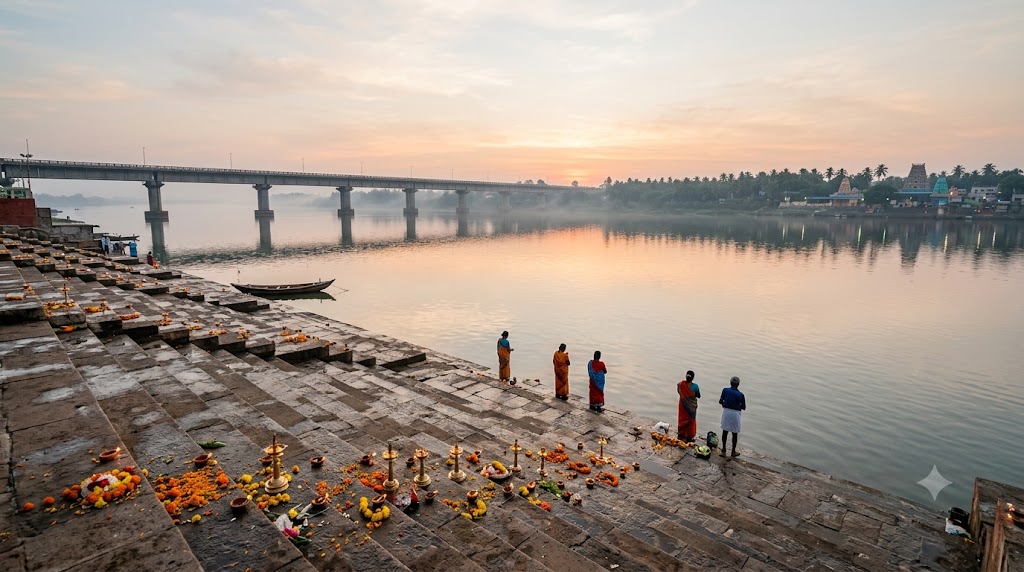
The main ghats each serve a purpose. Pushkar Ghat handles the principal holy dip, while Gowthami Ghat suits Pitru Tarpanam, the ritual for ancestors. Upstream and in Telangana, towns such as Bhadrachalam, Basara, Dharmapuri, and Kaleshwaram also host major snanams during the same window.
For ancestor rites, families often choose a confluence. Kaleshwaram, where the Godavari meets the Pranahita, is one such sangam where tradition says a dip carries doubled merit. These sites will remain central whenever the festival returns.
Should You Wait for the Next Godavari Pushkaralu or Go in 2027?
Honestly, if you can attend in 2027, go in 2027. Waiting for the next Godavari Pushkaralu in 2039 means a twelve-year gap, and circumstances change. The 2027 edition is fully confirmed, heavily funded, and the soonest chance to earn the merit of the holy dip.
There are real reasons some families will plan for 2039 instead. Health, age, finances, or distance may make 2027 impossible. A child too young in 2027 could attend 2039 as an adult, which makes it a natural family milestone. So the choice depends on your situation, not on which year is “better.”
My practical view is this. If 2027 is reachable, treat it as the priority and book early, because Rajahmundry rooms vanish fast. Keep 2039 as your backup window only if 2027 genuinely cannot work. Either way, the spiritual value of the dip is the same.
Pushkaram Misinformation Worth Ignoring
Several wrong claims circulate online, so it pays to know them before you plan. Correcting these is exactly where careless aggregator pages let pilgrims down.
“The 2027 festival starts in August.” It does not. The Andhra Pradesh government fixed 26 June to 7 July 2027. An older July–August window still floats around on some pages but stands superseded.
“2039 dates are already published.” They are not officially fixed yet, because panchangam scholars calculate them nearer the time. Any precise 2039 day shown today is an estimate, not a gazette notice.
“The Krishna Pushkaram is the same as Godavari’s.” They are separate. Krishna Pushkaralu follows in 2028, when Jupiter enters Kanya (Virgo), centred on Vijayawada. So Telugu families can attend both in back-to-back years.
“2039 is the next Maha Pushkaram.” No. The 2039 edition is an ordinary twelve-year Pushkaralu. The next Maha Pushkaram is 2159.
Holy River Dips Between 2027 and 2039
You do not have to wait until 2039 for a Pushkara dip somewhere in India. Because Jupiter moves through one sign each year, a different river celebrates its Pushkaram almost every year. So the twelve-year gap applies only to the Godavari, not to Pushkarams in general.
Krishna Pushkaralu arrives first, in 2028 at Vijayawada. After that, other rivers take their turn as Jupiter advances through the zodiac, returning to the Godavari only in 2039. Across those twelve years, the other eleven sacred rivers each take a turn, so a Pushkaram of some river runs in most years. A devotee who craves a holy river bath can therefore find one most years, just on a different river.
This matters for planning. If your goal is ancestor rites and a sacred dip, you have options between 2027 and 2039. If your heart is set specifically on the Godavari at Rajahmundry, then 2027 and 2039 are your two realistic windows.
Planning Ahead for the Next Godavari Pushkaralu
Planning for the next Godavari Pushkaralu in 2039 is less about exact dates and more about readiness. Since the year stays fixed, you can prepare long before the muhurtham is announced. A little foresight beats a last-minute scramble.
- Watch the official portals. The East Godavari district site and AP endowment department publish dates and ghat plans first.
- Pick your ghat by capacity, not fame. Smaller ghats like Dharmapuri or Antarvedi offer calmer dips than the crowded main ghat.
- Book stay and travel early. Rajahmundry fills first, so Kovvuru and Kakinada work as backup bases.
- Use an accredited priest. Gotra-based rituals go smoothly when a trained priest leads them, and the official pilgrim guidelines are worth reading before you travel.
- Carry essentials. A cloth bag for wet clothes helps, since most ghats ban plastic.
The Bottom Line
The next Godavari Pushkaralu after 2027 is firmly set for 2039, driven by Jupiter’s twelve-year return to Simha. Exact 2039 dates will arrive from the panchangam closer to the time, and they may fall a little earlier than the 2027 window. If you can manage it, attend the confirmed 2027 festival rather than waiting a full twelve years. For most pilgrims, the soonest sincere dip in the Godavari is the wisest one.
Frequently Asked Questions
When is the next Godavari Pushkaralu after 2027?
The next Godavari Pushkaralu after 2027 is in 2039. It follows the strict twelve-year cycle tied to Jupiter entering Simha rashi. The 2027 edition runs from 26 June to 7 July, so the next one lands twelve years later.
What are the exact 2039 Godavari Pushkaralu dates?
Exact 2039 dates are not officially fixed yet. Panchangam authorities will calculate them from Jupiter’s precise entry into Simha and publish them nearer the event. Based on the cycle, expect a window around June 2039.
Why does Godavari Pushkaralu come only once in twelve years?
The festival follows Jupiter, which takes about twelve years to circle the zodiac. The Godavari’s Pushkaram begins only when Jupiter enters Simha (Leo). Since that happens once per orbit, the festival returns once every twelve years.
Is 2039 the next Maha Pushkaram?
No, 2039 is an ordinary twelve-year Godavari Pushkaralu, not a Maha Pushkaram. People treated the 2015 festival as the 144-year Maha Pushkaram. The next Maha Pushkaram falls in 2159.
Where will the 2039 festival be held?
Rajamahendravaram (Rajahmundry) will again be the main hub in 2039. It has the most bathing ghats and pilgrim facilities on the Godavari. Towns like Bhadrachalam, Basara, and Kaleshwaram also host major snanams.
Should I go in 2027 or wait for 2039?
If you can attend in 2027, that is the better choice, since it is the soonest confirmed festival. Plan for 2039 only if 2027 is genuinely impossible due to age, health, or distance. The spiritual merit of the dip is identical in both years.
Can I take a Pushkara dip in another river before 2039?
Yes, a different river holds its Pushkaram almost every year as Jupiter changes signs. Krishna Pushkaralu, for example, follows in 2028 at Vijayawada. So you can earn a holy river dip without waiting for the Godavari’s 2039 turn.
Was the 2015 Godavari Pushkaram really special?
Yes, organisers promoted 2015 as a rare Maha Pushkaram, said to occur once in 144 years. It drew crores of pilgrims across Andhra Pradesh and Telangana. Some scholars dispute the 144-year theory, but the 2015 edition remains the most recent one held.

Godavari Pushkaralu Editorial is the team that researches, writes and maintains this site.
godavaripushkaralu.org.in is an independent pilgrim guide. It is not affiliated with, endorsed by, or the official website of any government body or temple administration, and it takes no bookings or payments.
How we work: festival dates come from the Andhra Pradesh government notification and the East Godavari district portal rather than from other guides. Jupiter’s transits, which set the twelve-year Pushkaram cycle, are checked against published panchangam transit tables. Claims about government arrangements — ghats, medical camps, transport, helpdesks — are attributed to their source or clearly marked as plans, because for a festival still months away most of them are plans. Volatile details such as fees and muhurtham clock times link out to the official portal instead of being fixed in our pages.
Every page here is re-checked on a fixed schedule and corrected when the facts move. If you find an error, tell us through the contact page and we will fix it.