
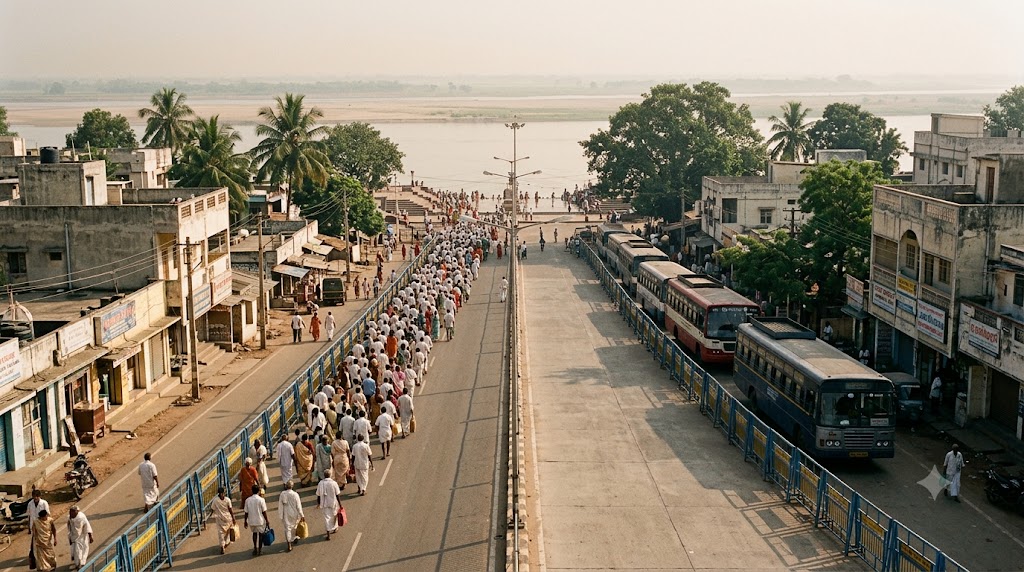
The Pushkaralu 2027 traffic plan is what most pilgrims want settled before they book travel to Rajahmundry. Here is the honest position, cleared up right at the start.
The full, street-by-street closure map is not out yet. Police issue those orders only in the weeks before a festival of this size. What is already clear is the framework, the scale, and the dates, so you can plan around it now.
One thing needs fixing straight away. Several websites still list this festival for late July, yet the state government has notified an earlier window. Get the date wrong and your whole trip collapses, so this guide begins there.
Independence note: This is an independent pilgrim guide. It is not the official website of the Andhra Pradesh government, the district administration, or the police, and it takes no bookings or payments. Please use the official portals linked below for any orders, passes, or reservations.
Pushkaralu 2027 traffic: quick facts
- Festival dates: 26 June to 7 July 2027, with the first holy dip at Brahma Muhurtam before dawn on 26 June.
- Main venue: Rajamahendravaram (Rajahmundry), reached by NH-16, Rajahmundry Junction, and Rajahmundry Airport.
- Crowd expected: officials estimate up to 10 crore devotees across the Godavari districts.
- Detailed closure map: not out yet; expect it from the city police close to the festival.
- Safe assumption: private cars will not reach the ghats, so plan for outer parking and a shuttle or walk.
The confirmed dates, and the wrong ones to ignore
The Andhra Pradesh government has notified the festival for 26 June to 7 July 2027. The state fixed this window on the advice of the Tirumala Tirupati Devasthanams (TTD) chief astrologer, and it also appears on the district administration’s own pages.
The first and most powerful holy dip falls at Brahma Muhurtam on 26 June. For the full daily bathing schedule, our Pushkaralu 2027 dates and muhurtham guide lays it out day by day.
Many aggregator pages still show July 23 to August 3, or even July 27 to August 7. Those were early, provisional figures quoted before the gazette notification, so they are now outdated. If a travel agent or a website quotes late July, treat it as a red flag and check an official source.
What the Pushkaralu 2027 traffic plan covers
The Pushkaralu 2027 traffic plan is a citywide framework to move up to 10 crore pilgrims safely to the riverbank and back. It centres on dedicated entry and exit routes to each ghat, outer parking with shuttle links, heavy-vehicle limits, and AI-based crowd and traffic monitoring. Free flow to the ghats is the whole point.
Chief Minister N. Chandrababu Naidu reviewed these arrangements in early 2026. He ordered a comprehensive plan to prevent congestion, vehicle pile-ups, and fire risks in the tent cities.
The district Superintendent of Police has said officials are drawing up separate routes for devotees to reach the bathing ghats. Planners have also added temporary bridges and buffer zones, since the event follows the scale of the Maha Kumbh Mela.
Has the detailed plan been released yet?
No. Officials have approved the framework, but the exact road closures, diversion points, and parking grounds are not public yet. For a festival this large, police finalise those orders only weeks before the first dip, once ghat construction and crowd estimates are ready. Watch the Rajamahendravaram City Police and district administration announcements as June 2027 nears.
Pushkaralu 2027 traffic plan: expected road closures and diversions
While the official orders are still pending, the likely shape of the closures is clear. It follows how the 2015 event ran and what officials have already stated. Treat the points below as an informed expectation, not a final order, and confirm them nearer the date.
The riverfront roads and the lanes feeding the main ghats will almost certainly turn into vehicle-free zones on peak days. Pushkar Ghat, Gowthami Ghat, Kotilingala Ghat, and Saraswati Ghat sit in a dense city core.
So the police typically ring-fence that core and route walkers in on foot. Expect one-way loops around the ghat cluster to stop head-on crowd flow. Our Rajahmundry ghats guide maps where each of these ghats sits.
Police usually hold heavy vehicles, tourist buses, and lorries at checkposts on the city’s outer edge. From there, pilgrims transfer to shuttles or walk the last stretch. Because private cars clogged every arterial road in 2015, the Pushkaralu 2027 traffic plan leans harder on outer parking and public shuttles to keep the centre moving.
How ghat-wise routing works
The Pushkaralu 2027 traffic plan splits pilgrims by ghat rather than sending everyone to one riverbank. Each major ghat gets its own approach corridor, its own queue, and a separate exit path. This keeps arriving and departing crowds from colliding at the water’s edge.
It also lets police close or open a single corridor quickly if one ghat fills up. For you, this means the entry route you use will depend on which ghat you choose or get assigned.
Emergency and medical lanes
Keeping ambulances moving is a core aim of the Pushkaralu 2027 traffic plan. In 2015, the state deployed about 1,694 health staff, along with road and boat ambulances, so clear lanes for them matter as much as pilgrim routes. Expect reserved emergency corridors that stay open even when other roads shut. Note the nearest medical camp when you arrive, since it saves precious minutes in a crowd.
Where you will actually park
Plan to park on the outskirts, not near the water. The proven model uses large satellite parking grounds on the approach roads, linked to the ghats by frequent shuttle buses.
Your own vehicle stays parked while you finish the dip and rituals, so pack light and keep valuables with you. The final Pushkaralu 2027 traffic plan will number the parking sites and shuttle points.
How to reach Rajahmundry during Pushkaralu
Rajahmundry is well connected, which matters when police tightly control road entry into the city. Rail is usually the least stressful choice during a Pushkaram, because trains bypass the road jams entirely. Special Pushkar trains and extra APSRTC buses run through the festival window.
By air, Rajahmundry Airport sits about 15 km from the city and links to Hyderabad, Bengaluru, and Chennai. By train, Rajahmundry Junction lies on the Howrah–Chennai main line, so direct services reach it from most metros. By road, NH-16 is the spine, although you should expect diversions and outer parking once you near the city.
| Arrival mode | Entry point | What to expect |
|---|---|---|
| Train | Rajahmundry Junction | Best option on peak days; short shuttle or walk to ghats |
| Air | Rajahmundry Airport (~15 km) | Taxi to an outer point, then shuttle in |
| Road (car) | NH-16, outer parking grounds | Diversions likely; park outside and shuttle or walk |
| Bus | APSRTC Pushkar terminals | Extra services; drops near shuttle points |
Best time to travel, and the day to avoid
The first day draws the heaviest crowd by far, so the roads and ghats face the most strain on 26 June. If you can, choose a middle day of the 12-day window for a calmer dip and lighter traffic. The holy merit runs through all twelve days, so an early-morning dip on day three or four is spiritually complete and far safer.
What 2015 taught the planners
The 2015 Godavari Maha Pushkaram drew close to a crore people to Rajahmundry and exposed real gaps. Private vehicles flooded every route into the city, and traffic jams then choked the roads on more than half of the twelve days. Officials had not planned food and water for people stuck in those jams, which they later flagged as a clear lesson.
The gravest lesson came on the first morning. A stampede at Pushkar Ghat killed 27 pilgrims within hours of the opening dip.
That hard lesson shapes the Pushkaralu 2027 traffic plan today. Officials now spread devotees across hundreds of ghats, stagger access, and separate entry from exit, rather than funnelling everyone to one riverbank. You can read the full crowd rules in our Pushkaralu 2027 guidelines.
Heat, crowds, and who should take extra care
Late June in the Godavari delta is hot and humid, so heat and dehydration are genuine risks in a slow-moving queue. Carry water, wear light cotton, and keep any regular medication on you.
If you have a medical condition, please check with your doctor before a long, strenuous trip, because the rituals are a matter of faith and never a substitute for medical care.
Watch out for fake parking passes and ghat access
No private agent can sell you a genuine “VIP ghat pass” or a guaranteed parking permit, so do not pay for one. The police manage ghat access and parking free of charge on the ground. Book only verified hotels, and never hand money to unknown agents offering shortcuts, because these scams spike during every Pushkaram.
What experienced Pushkaram-goers do differently
- They arrive a day early and settle in, so they never drive on the packed first morning.
- They take the train where possible, because it sidesteps the road jams completely.
- They fix a meeting point with family, since mobile networks choke when lakhs gather.
- They keep a photo of any companion on their phone in case of separation.
- They finish the dip early, then leave the ghat quickly so others can move in.
Before you set out
The full Pushkaralu 2027 traffic plan will surface closer to the festival, yet the smart moves are already obvious. Lock in the 26 June to 7 July window, favour the train, park on the outskirts, and skip the first-day peak if crowds worry you.
Above all, confirm the final road orders from the city police before you travel, so a late diversion never catches you off guard. You can cross-check dates and district plans on the official East Godavari district portal and the wider Andhra Pradesh government portal. Plan early, travel light, and let the ghats do the rest.
Pushkaralu 2027 traffic: frequently asked questions
When will the Pushkaralu 2027 traffic plan be released?
The detailed plan usually surfaces only in the weeks before the festival. Police finalise closures and parking once ghat work and crowd numbers are ready. Watch the Rajamahendravaram City Police and district administration for the official orders as June 2027 nears.
Can I drive my car right up to the ghats?
No. Police keep private vehicles out of the ghat core on busy days. You will park at an outer ground and reach the river by shuttle bus or on foot, so plan for that final stretch.
What are the confirmed Pushkaralu 2027 dates?
The festival runs from 26 June to 7 July 2027. The first holy dip falls at Brahma Muhurtam before dawn on 26 June. Ignore the older July 23 to August 3 dates that some sites still show.
Which is the best way to reach Rajahmundry during Pushkaralu?
Train is usually the easiest, because it avoids the road congestion around the city. Rajahmundry Junction sits on the Howrah–Chennai main line, and special Pushkar trains run through the festival. Extra APSRTC buses operate as well.
Where will I be able to park?
Expect large parking grounds on the city’s approach roads, away from the river. Shuttle buses link these grounds to the ghats. The final police plan will number the exact sites, so check the official notice before you drive in.
Will there be special buses and trains?
Yes. The government runs special Pushkar trains and extra APSRTC buses during the 12-day window. These extra services are the recommended way to reach Rajahmundry, since they cut out the worst of the traffic.
Is the first day safe for pilgrims?
The first day is the most crowded and the most stressful, so unwell pilgrims should avoid it. A quiet early-morning dip on a middle day carries the same spiritual merit. Anyone with a health condition should consult a doctor before travelling.

Godavari Pushkaralu Editorial is the team that researches, writes and maintains this site.
godavaripushkaralu.org.in is an independent pilgrim guide. It is not affiliated with, endorsed by, or the official website of any government body or temple administration, and it takes no bookings or payments.
How we work: festival dates come from the Andhra Pradesh government notification and the East Godavari district portal rather than from other guides. Jupiter’s transits, which set the twelve-year Pushkaram cycle, are checked against published panchangam transit tables. Claims about government arrangements — ghats, medical camps, transport, helpdesks — are attributed to their source or clearly marked as plans, because for a festival still months away most of them are plans. Volatile details such as fees and muhurtham clock times link out to the official portal instead of being fixed in our pages.
Every page here is re-checked on a fixed schedule and corrected when the facts move. If you find an error, tell us through the contact page and we will fix it.