
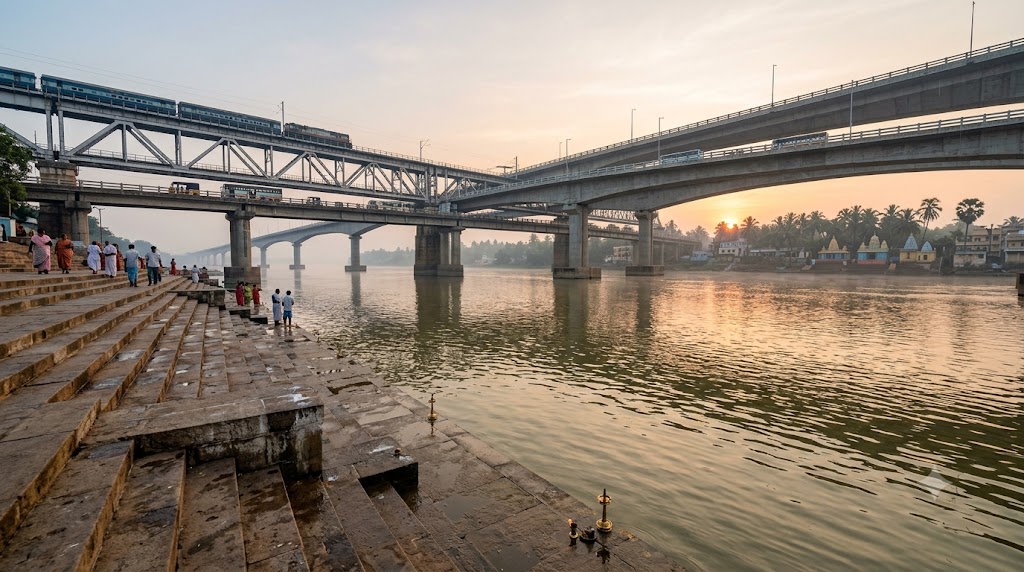
The Rajahmundry Pushkar ghat routes you pick for Godavari Pushkaralu 2027 will shape your whole day. They decide how long you queue, how far you walk, and which holy dip you reach. In short, the road matters as much as the ritual.
First, make sure you want this Kotilingala. Two places on the Godavari carry the name. This page is about Kotilingala Ghat in Rajahmundry, East Godavari district, Andhra Pradesh — a bathing ghat inside the city. The other is Kotilingala village in Jagtial district, Telangana, the archaeological site many historians call the first Satavahana capital, roughly 500 km upriver. Pilgrims dip at both during Pushkaralu, and they are not a day trip from each other. If you came looking for the Telangana one, read accommodation near Kotilingala Ghat in Jagtial instead.
Two ghats sit at the centre of most plans. Saraswati Ghat lies in the heart of the city, while Kotilingala Ghat sits further along the river. This guide maps the roads to both, so you can move from the station, bus stand or airport with a plan.
Independent guide: godavaripushkaralu.org.in is an independent pilgrim guide. We are not the official website of the government, the district administration, or any temple trust. We are not affiliated with them either.
Also, we take no bookings, donations or payments. For schedules and official transport, please use the government portals linked below instead.
Quick facts before you set out
- Festival window: Godavari Pushkaralu 2027 runs from 26 June to 7 July, so it is a 12-day festival.
- Saraswati Ghat: in Tyagaraja Nagar, about 2 to 3 km from Rajahmundry Junction, and best for Aksharabhyasam.
- Kotilingala Ghat: near the AP Paper Mill, about 6 km from the centre, since it lies downstream.
- Between the two: around 5 to 6 km of riverfront road, so many families do both in one trip.
- Peak days: expect park-and-ride, special buses and vehicle curbs when crowds peak near the ghats.
Rajahmundry Pushkar ghat routes: the 2027 picture
First, the date. The gazetted Godavari Pushkaralu 2027 window is 26 June to 7 July, since the muhurtham is now fixed. The East Godavari district administration confirmed it.
Several older news reports still show July 23 to August 3. Some copycat sites even show July 27 to August 7. Those figures are outdated, so plan around late June instead. Our muhurtham calendar lists the daily timings.
Why do routes matter so much? Because Rajahmundry becomes one of India’s largest gatherings for 12 days, single-ghat crowding turns into the biggest risk. The city therefore spreads pilgrims across dozens of ghats on purpose.
When you know your road in advance, you skip the last-minute scramble. That scramble is what clogs junctions and slows everyone down. Good Rajahmundry Pushkar ghat routes are really a safety tool. Saraswati Ghat and Kotilingala Ghat also draw different crowds, since each one serves a different ritual.
Where the two ghats sit on the river
Both ghats line the same left bank of the Godavari. Yet they sit several kilometres apart, so getting this map right saves a wrong turn on a packed morning. Your Rajahmundry Pushkar ghat routes depend on which ghat you choose first.
Saraswati Ghat, T Nagar
Saraswati Ghat stands in Tyagaraja Nagar, close to the ISKCON temple and the famous road-cum-rail bridges. This is the central, easy-to-reach ghat, since it sits only 2 to 3 km from Rajahmundry Junction.
The ghat is named after Goddess Saraswati. Families flock here for Aksharabhyasam, a child’s first letters, and for Saraswati Puja. Because it faces the three bridges, it is also the most photographed stretch of the river.
Kotilingala Ghat, Paper Mill area
Kotilingala Ghat lies at Kotilingalapeta in the AP Paper Mill area, near Sithampeta. It grew around the Sri Uma Kotilingeswara Swamy temple. Since the ghat stretches over a kilometre, it is the longest bathing ghat in Rajahmundry.
Local tradition ties it to the legend of one crore Shiva lingas. Devotees come here for Shiva abhishekam, and also for ancestor rituals such as tarpanam. It sits about 6 km from the centre, roughly a 15-minute drive when traffic is light.
Rajahmundry Pushkar ghat routes to Saraswati Ghat
The Rajahmundry Pushkar ghat routes to Saraswati Ghat are the simpler of the two, because the ghat sits right inside the city. From Rajahmundry Junction, an auto or taxi covers 2 to 3 km in 10 to 15 minutes. The usual approach runs through the city centre, then toward the ISKCON temple road and the riverfront at T Nagar.
Arriving by bus? From the main APSRTC bus stand, head toward Devi Chowk and the riverfront, since it is a short hop of a few kilometres. If you land at Rajahmundry Airport (Madhurapudi), the ghat is about 15 to 18 km away, so a pre-booked cab or app taxi is the smoothest option.
On busy mornings, the last stretch near the ghat is often closed to vehicles. Drivers then drop you at a marked point, and you walk the final few hundred metres. Because Saraswati Ghat sits in a dense residential area, avoid bringing a large vehicle up to the steps on peak days.
Rajahmundry Pushkar ghat routes to Kotilingala Ghat
Kotilingala Ghat has three main approach roads, so knowing them helps you skip the worst jams. Traffic reaches the ghat through Gokavaram Bus Stand Road, Seethanagaram Road, or Krishna Nagar Road. Each one feeds the temple complex from a different direction.
Coming from the station or centre, the Gokavaram Bus Stand Road side is usually most direct. Drivers from the outskirts often prefer the Seethanagaram Road approach, while Krishna Nagar Road serves the local neighbourhoods nearby. Since the ghat is set back from the core city, its parking areas tend to be larger than the cramped lanes near Saraswati Ghat.
The trade-off is distance, because you travel about 6 km from the centre. Factor in extra time on peak days, when the paper mill stretch slows to a crawl. These Rajahmundry Pushkar ghat routes reward an early start, since arriving before sunrise beats both the heat and the vehicle rush.
The route between Saraswati Ghat and Kotilingala Ghat
Many pilgrims want both ghats in one visit, one for Saraswati Puja and one for Shiva abhishekam. The two are about 5 to 6 km apart along the riverfront and city roads. On a normal day that is a 15 to 20 minute drive, though festival traffic can easily double it.
A sensible order is to start early at Kotilingala Ghat, since it is farther out and fills up as the morning warms. After your dip and rituals there, head back toward the city for Saraswati Ghat, which stays busy into the evening. If shuttle buses run between ghats, use them, because private vehicles struggle most on the middle stretch.
Quick route comparison
| Detail | Saraswati Ghat | Kotilingala Ghat |
|---|---|---|
| Area | Tyagaraja Nagar (T Nagar) | Kotilingalapeta, Paper Mill area |
| From Rajahmundry Junction | About 2 to 3 km | About 6 km |
| Main approach | City centre, ISKCON temple road | Gokavaram Bus Stand, Seethanagaram, Krishna Nagar roads |
| Best for | Aksharabhyasam, Saraswati Puja | Shiva abhishekam, ancestor rituals |
| Parking | Tight, city lanes | Larger, set-back areas |
In plain numbers, Saraswati Ghat is the near, central option at 2 to 3 km. Kotilingala Ghat, meanwhile, is the larger ghat about 6 km out, with three feeder roads.
Rajahmundry Pushkar ghat routes on peak days
Rajahmundry Pushkar ghat routes change on the busiest days, when the opening dip on 26 June and the closing day on 7 July draw the heaviest crowds. On these days, authorities usually shut riverfront roads to private traffic. Instead, they run a park-and-ride system with dedicated APSRTC Pushkar buses, while special trains also run into Rajahmundry Junction.
In 2015 the state used around 300 GPS-fitted buses, so it could steer pilgrims toward less crowded ghats. A similar plan is expected for 2027. Park at the ground on the city outskirts, board the shuttle, and let it drop you near your ghat.
Driving to the steps on a peak morning almost never works, so build the shuttle leg into your timing. Exact parking grounds, bus routes and e-pass rules for 2027 will come closer to the date. Meanwhile, confirm them on the East Godavari district portal, and check services on APSRTC online.
Autos stay useful for the shorter Saraswati Ghat runs on lighter days, though fares climb during the festival. Agree on the fare before you sit. Also, never trust a stranger who promises a private shortcut or a paid queue jump.
Staying safe on the ghat routes
Safety planning is not optional here, and the reason is sobering. On the first day of the 2015 Godavari Maha Pushkaram, a crowd crush hit the main Pushkar Ghat. It took at least 27 lives, according to officials, after tens of thousands rushed a single ghat thought to be the holiest.
The lesson shaped every plan since. Spread out, use your assigned ghat, and follow the marshals. Our safety guidelines cover the crowd rules in full.
The festival falls in the pre-monsoon heat of late June, so carry water and expect long walks from the drop points. Steps down to the water can be wet and slippery, so both ghats get slick underfoot. Pilgrims anyone with a heart or mobility condition should keep to calmer hours. Then ask a helpdesk about accessible entry points.
Ritual and faith practices are matters of tradition, not medical treatment. If you plan to fast before a dip, or walk far in the heat, speak to a doctor first when you have a health condition. Move with your group, note the nearest medical camp, and keep a phone contact written on paper since networks often jam.
What experienced pilgrims do differently
Regulars rarely aim for the most famous ghat at the most famous hour. Instead, they pick a ghat by capacity and access, then arrive in the pre-dawn calm. That habit alone cuts your queue and your risk.
They also scout the drop point the evening before, so the morning route holds no surprises. Keep footwear minimal and carry it in a bag, because shoe stands overflow fast. Bring a dry set of clothes and a little cash for the auto.
Carry nothing valuable you would mind losing in a crush, and a small torch also helps on unlit lanes before sunrise. One more local trick: eat light and early, since the walk plus the heat plus a crowd is no place for a heavy stomach. Buttermilk and coconut water from the stalls keep you going better than a big meal.
Before you go
The right route turns a stressful festival day into a smooth one. First, fix your ghat, learn its approach roads, and plan around the park-and-ride rather than fighting it. Start at Kotilingala Ghat early for the longer trip, then swing back to Saraswati Ghat in the city.
Plan your Rajahmundry Pushkar ghat routes around the crowd guidance, because that guidance keeps you safe. For more on ghats and timings, see our Rajahmundry ghats guide.
Frequently asked questions
How far is Saraswati Ghat from Rajahmundry railway station?
Saraswati Ghat is about 2 to 3 km from Rajahmundry Junction. That is roughly a 10 to 15 minute auto ride on a clear day. It sits in Tyagaraja Nagar, near the ISKCON temple. Festival traffic can stretch that time, so leave early.
How do I reach Kotilingala Ghat in Rajahmundry?
Kotilingala Ghat sits near the AP Paper Mill, about 6 km from the centre. Three roads lead in, namely Gokavaram Bus Stand Road, Seethanagaram Road, and Krishna Nagar Road. From the station, the Gokavaram Bus Stand Road side is usually most direct.
Can I visit both ghats in one day?
Yes. Since the two ghats are about 5 to 6 km apart, one trip is very doable. Start early at Kotilingala Ghat, because it is farther out, then move back to the central Saraswati Ghat. Also allow extra time for festival traffic.
What are the correct Godavari Pushkaralu 2027 dates?
Godavari Pushkaralu 2027 runs from 26 June to 7 July. This is the gazetted window confirmed by the district administration. Older reports showing July 23 to August 3 are outdated, so plan for late June.
Will private vehicles be allowed near the ghats?
On peak days, private vehicles are usually barred from the riverfront near the ghats. Instead, authorities run a park-and-ride system with special buses. Park at the marked ground, then take the shuttle. Confirm the exact 2027 rules on the official portal.
Which ghat is better for ancestor rituals?
Kotilingala Ghat is a popular choice for Shiva abhishekam and ancestor rituals such as tarpanam. Gowthami Ghat is also widely used for Pitru Tarpanam. For children’s Aksharabhyasam and Saraswati Puja, meanwhile, Saraswati Ghat is the traditional spot.
When should I arrive to avoid the worst crowds?
Aim for the pre-dawn hours, ideally before sunrise, since the ghats fill quickly after first light. Weekdays are calmer than weekends. The opening and closing days draw the heaviest crowds, so early arrival also spares you the late-morning heat.

Godavari Pushkaralu Editorial is the team that researches, writes and maintains this site.
godavaripushkaralu.org.in is an independent pilgrim guide. It is not affiliated with, endorsed by, or the official website of any government body or temple administration, and it takes no bookings or payments.
How we work: festival dates come from the Andhra Pradesh government notification and the East Godavari district portal rather than from other guides. Jupiter’s transits, which set the twelve-year Pushkaram cycle, are checked against published panchangam transit tables. Claims about government arrangements — ghats, medical camps, transport, helpdesks — are attributed to their source or clearly marked as plans, because for a festival still months away most of them are plans. Volatile details such as fees and muhurtham clock times link out to the official portal instead of being fixed in our pages.
Every page here is re-checked on a fixed schedule and corrected when the facts move. If you find an error, tell us through the contact page and we will fix it.