
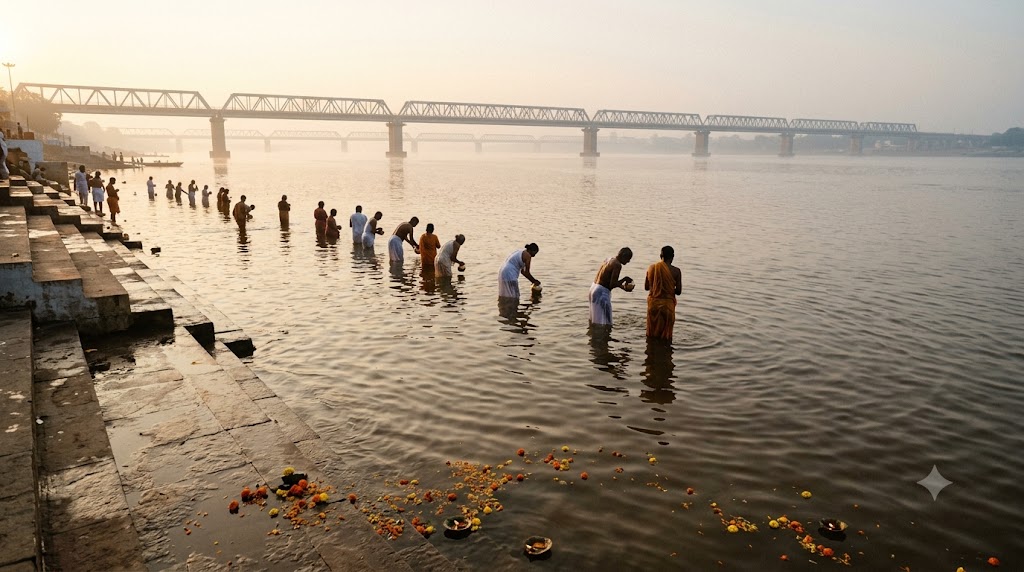
The Godavari Pushkaralu holy dip is believed to wash away the sins of seven generations. That single belief explains why crores of pilgrims will pour onto the riverbanks at Rajahmundry in 2027. This once-in-twelve-years bath is not just a ritual splash. It carries deep scriptural meaning, a fixed astronomical trigger, and a set of ancestral rites that most first-time visitors never fully understand.
This guide explains what the sacred bath actually signifies, when the holiest moments fall in 2027, and how to take the dip safely. Because misinformation about the dates still circulates online, the correct, government-confirmed schedule matters more than ever.
godavaripushkaralu.org.in is an independent information guide. It is not affiliated with, endorsed by, or the official website of the Government of Andhra Pradesh or any temple authority. We take no bookings, donations, or payments. Use the official portals linked below for arrangements and confirmed details.
Godavari Pushkaralu holy dip: quick facts at a glance
- Festival window: 26 June to 7 July 2027, confirmed by the East Godavari district administration.
- Astronomical trigger: Brihaspati (Jupiter) enters Simha rashi (Leo).
- Holiest moment: the first dip at Brahma Muhurtam before dawn on 26 June 2027.
- Main hub: Rajamahendravaram (Rajahmundry), on the banks of the Godavari.
- Core belief: the bath purifies the soul and honours departed ancestors.
- Frequency: once every twelve years, when Jupiter circles back to Leo.
What makes the Godavari Pushkaralu holy dip so significant?
The Godavari Pushkaralu holy dip is significant because devotees believe a divine energy called Pushkara enters the river for these twelve days. During this window, a bath is said to cleanse lifetimes of sin and grant spiritual merit. This belief, rooted in Vedic tradition, is why the ordinary river becomes a place of pilgrimage.
The Sanskrit word Pushkaram points to something that nourishes and gives strength. So the festival is understood as a time when the water itself carries a purifying charge. Sages taught that when Pushkara is present, even a single dip equals the merit of bathing in many sacred rivers over years.
Pushkaram follows Jupiter through the zodiac. Because the Godavari is linked to Simha rashi, its turn comes only when Jupiter enters Leo. Since Jupiter takes roughly twelve years to complete one orbit, the festival returns just once in twelve years. That rarity is a large part of why the dip feels so charged for devotees.
The legend behind the sacred bath
The story starts with a devotee named Pushkara, who worshipped Lord Shiva with deep devotion. Shiva granted him the power to purify water. Lord Brahma later asked Pushkara to live within the sacred rivers so that people could be cleansed by bathing in them.
To decide which river Pushkara would bless and when, Brahma paired him with Brihaspati, the planet Jupiter. So as Jupiter moves from one sign to the next, Pushkara moves with it into a different river. When Jupiter enters Leo, Pushkara enters the Godavari. This is the quiet logic behind the whole festival calendar.
Devotees see the Godavari not merely as water but as a living goddess. While the science of the calendar rests on Jupiter, the emotion rests on this ancient bond between a devotee, a boon, and a river.
When is the Godavari Pushkaralu holy dip in 2027?
The Godavari Pushkaralu holy dip runs from 26 June to 7 July 2027, a twelve-day period confirmed by the East Godavari district administration. The festival begins the moment Jupiter enters Leo. Devotees consider the very first dip on the opening morning the most auspicious of all.
Here is where readers must be careful. Several websites still list an August 2027 start, and a few show a July 23 to August 3 window. Those dates no longer apply, and the government has moved on from them. The official schedule is 26 June to 7 July 2027, and that is the one to plan around.
| Detail | 2027 information |
|---|---|
| Start date | 26 June 2027 (first dip at Brahma Muhurtam) |
| End date | 7 July 2027 |
| Duration | 12 sacred days (Adi Pushkaram) |
| Trigger | Jupiter enters Simha rashi (Leo) |
| Main location | Rajahmundry, on the Godavari |
The previous Godavari Pushkaram fell in 2015. After 2027, the next one will not arrive until 2039. For a fuller breakdown of the cycle, see our guide to the next Godavari Pushkaralu in 2039.
Best muhurtham for the Godavari Pushkaralu holy dip
The best muhurtham for the Godavari Pushkaralu holy dip is Brahma Muhurtam on 26 June 2027, the pre-dawn hour when the festival begins. This first window, roughly the opening twelve hours, is considered the peak of the entire event. The final twelve hours on 7 July 2027 are held to be equally sacred.
Priests divide the festival into two special phases. The first twelve days form the Adi Pushkaram, when Pushkara’s presence is strongest. A later phase, the Anthya Pushkaram, marks the closing days before Jupiter leaves Leo.
Early morning is the traditional time to bathe, because dawn is linked with the highest merit. Yet the first-day rush is intense, so many families instead choose a quieter dawn later in the twelve days. Both choices are valid. For the daily breakdown, check our full Godavari Pushkaralu 2027 muhurtham calendar.
Does the exact minute of the dip matter?
Not as much as many pilgrims fear. While the opening muhurtham carries special weight, the entire twelve-day window stays sacred. A safe, unhurried dip on day four counts fully. Rushing into a dangerous crowd to catch one minute is neither required by tradition nor wise.
The five-fold worship: what pilgrims actually do
The holy dip is only one part of a fuller observance. Tradition describes five acts of worship during Pushkaram. Together they turn a bath into a complete spiritual practice.
- Darshanam — viewing and honouring the sacred river.
- Snanam — the holy dip itself, the central act.
- Daanam — charity, such as offering food or clothing to the needy.
- Tarpanam — offering water to departed ancestors.
- Samarpanam — surrender and prayer to the river.
Ancestral rites sit at the heart of Pushkaram. After the dip, many families perform Pitru Tarpanam and Pinda Pradanam for their forebears. Devotees believe these offerings help departed souls find peace. Because of this, the festival is as much about remembering ancestors as it is about personal cleansing.
Priests sit along the ghats and guide these rituals. If you plan to perform Tarpanam, carry the simple items your family priest recommends. So the sequence usually runs dip first, then ancestral offerings, then charity.
Where to take the Godavari Pushkaralu holy dip in Rajahmundry
Rajahmundry hosts several major ghats, and each serves a slightly different purpose. Spreading out across them is not just practical. It is the single best way to stay safe when the crowds swell.
| Ghat | Known for |
|---|---|
| Pushkar Ghat (Kotagummam) | The main, best-equipped ghat for the holy dip and the evening Godavari Harathi. |
| Kotilingala Ghat | The Sri Umakotilingeswara Shiva temple and Shiva abhishekam. |
| Gowthami Ghat | A favoured spot for Pitru Tarpanam and ancestral rites. |
| Saraswati Ghat (VIP Ghat) | Children’s Aksharabhyasam and calmer bathing. |
| Markandeya Ghat | An older riverside ghat, useful for spreading the crowd. |
Pushkar Ghat is the most famous and therefore the most crowded. During the 2015 festival, tens of thousands converged on it alone. So if your goal is a calm, safe dip, a smaller ghat is often the wiser pick. For a fuller map, see our Rajahmundry ghats guide.
How to take the holy dip the right way
The ritual is simple, and you do not need elaborate preparation. Following a clear sequence helps you stay calm and safe in a heavy crowd.
- Reach the ghat early and note the marked entry and exit gates before you move to the water.
- Leave footwear and valuables with a family member, since lost shoes have triggered crowd surges here before.
- Face the sunrise, take three gentle dips, and offer a short prayer to the river.
- Perform Tarpanam for ancestors with a priest’s help if your family observes it.
- Move away from the water promptly so others can bathe, then complete any charity.
Keep the dip brief. The merit lies in the intention and the sacred moment, not in how long you stay in the water. Because the river current can be strong, stay within the roped bathing zone at all times.
Safety first: the hard lesson from 2015
The holy dip is a moment of faith, but crowd safety is a matter of life. On the first morning of the 2015 Pushkaram, a stampede at Rajahmundry’s Pushkar Ghat killed at least 27 pilgrims, most of them women, according to district officials. Tens of thousands had surged toward a single gate to catch the opening muhurtham.
That tragedy holds a clear lesson for 2027. The belief that the first dip carries the highest merit is exactly what drives the dangerous rush. Yet tradition never asks a devotee to risk their life. A safe dip on any of the twelve days brings the same blessing.
A few precautions protect you and your family:
- Avoid the first-day peak hours if you are pregnant, or travelling with small children.
- Hold children firmly and never let them near deep or fast-moving water.
- Follow police and ghat marshals, and use only the official bathing zones.
- Carry drinking water, since long queues and summer heat cause exhaustion.
- Agree on a meeting point in case the crowd separates your group.
The spiritual benefits of the dip are matters of faith and tradition. They are not a substitute for medical care. If you have a heart condition or mobility issues, consult a doctor before joining a strenuous, crowded pilgrimage.
What first-time pilgrims often get wrong
Many visitors assume the busiest ghat is the holiest. It is not. All the Rajahmundry ghats carry the same Pushkara presence during the festival, so a quieter ghat offers the same merit with far less risk.
Another common mistake is treating the dip as the whole festival. In truth, the ancestral rites and charity complete the observance. Families who plan for Tarpanam in advance leave far more fulfilled.
Some pilgrims also arrive without booking a place to stay. Rajahmundry fills up fast during Pushkaram. Because private touts often overcharge during the rush, arrange accommodation only through official or authorised channels, and confirm current rates on the district portal.
Before you go: the essentials
The Godavari Pushkaralu holy dip in 2027 is a rare chance to take part in a tradition that returns only once in twelve years. Mark the correct window, 26 June to 7 July 2027, and ignore the outdated August dates still floating online. Choose a safe ghat, keep the dip brief, and give the ancestral rites the time they deserve. Plan early, stay patient in the crowd, and let the meaning of the moment matter more than the minute.
Frequently asked questions
What is the significance of the Godavari Pushkaralu holy dip?
The Godavari Pushkaralu holy dip is believed to cleanse sins and grant spiritual merit, because the divine energy of Pushkara is said to enter the river during the festival. Devotees also use the occasion to honour departed ancestors through Tarpanam. It happens only once every twelve years.
What are the exact 2027 dates?
The festival runs from 26 June to 7 July 2027, as confirmed by the East Godavari district administration. Some websites still show an August window, but those dates no longer apply. The twelve-day period is the officially recognised schedule.
What is the most auspicious time for the holy dip?
The first dip at Brahma Muhurtam before dawn on 26 June 2027 is considered the holiest. The opening twelve hours and the closing twelve hours on 7 July carry special merit. Even so, any dawn during the twelve days is deeply sacred.
Which ghat is best for the holy dip in Rajahmundry?
Pushkar Ghat is the main and best-equipped ghat, but it is also the most crowded. For a calmer, safer dip, Saraswati Ghat or Markandeya Ghat are good choices. All ghats carry the same sanctity during Pushkaram.
Do I need a priest for the holy dip?
No priest is required for the dip itself. However, if you wish to perform Tarpanam or Pinda Pradanam for ancestors, a priest at the ghat can guide the rituals. Many families choose to do so.
Is the Godavari Pushkaralu holy dip safe for pilgrims?
It can be, with care. pilgrims should avoid the first-day peak hours and choose a quieter ghat and a calmer time. Anyone with a health condition should consult a doctor before joining the crowds.
When is the next Godavari Pushkaralu after 2027?
The next Godavari Pushkaralu falls in 2039, twelve years later, when Jupiter again enters Leo. The exact 2039 dates are not yet gazetted. Panchangam authorities will calculate them nearer the event.
How many people are expected in 2027?
The Andhra Pradesh government is planning for an enormous turnout, with press reports citing official estimates of several crore devotees across the Godavari districts. Exact figures depend on final arrangements. Early planning and off-peak timing are strongly advised.
For official arrangements, helpdesk details, and confirmed schedules, always refer to the East Godavari district Pushkaralu portal and the Government of Andhra Pradesh website.

Godavari Pushkaralu Editorial is the team that researches, writes and maintains this site.
godavaripushkaralu.org.in is an independent pilgrim guide. It is not affiliated with, endorsed by, or the official website of any government body or temple administration, and it takes no bookings or payments.
How we work: festival dates come from the Andhra Pradesh government notification and the East Godavari district portal rather than from other guides. Jupiter’s transits, which set the twelve-year Pushkaram cycle, are checked against published panchangam transit tables. Claims about government arrangements — ghats, medical camps, transport, helpdesks — are attributed to their source or clearly marked as plans, because for a festival still months away most of them are plans. Volatile details such as fees and muhurtham clock times link out to the official portal instead of being fixed in our pages.
Every page here is re-checked on a fixed schedule and corrected when the facts move. If you find an error, tell us through the contact page and we will fix it.