Ask any devotee why the Godavari Dakshina Ganga carries such reverence, and the answer runs deeper than geography. This river is the sacred twin of the northern Ganga, honoured across peninsular India for its purifying waters, its Puranic legend, and the temple towns strung along its banks. Millions bathe in it to wash away sin, just as pilgrims do at Varanasi. Yet the story of how a river born in Maharashtra came to be called the Ganga of the South is richer than most guides ever tell.
Godavari Pushkaralu (godavaripushkaralu.org.in) is an independent pilgrim guide. It is not the official Godavari Pushkaralu or government website, and it takes no bookings, donations, or payments. Use the official district and endowment portals for arrangements.
The Godavari Dakshina Ganga at a Glance
- Meaning: “Dakshina Ganga” means the Ganga of the South, a title of spiritual equality with the northern Ganga.
- Length: About 1,465 km, the longest river in peninsular India and the second-longest in the country.
- Source: Brahmagiri Hills at Trimbakeshwar, near Nashik in Maharashtra.
- Other names: Gautami Ganga, Vriddha Ganga, and simply Goda.
- Sacred cycle: The Godavari Pushkaralu returns once every 12 years, next in 2027.
What Does “Godavari Dakshina Ganga” Actually Mean?
The Godavari Dakshina Ganga means the “Ganga of the South.” Devotees give the river this title because it holds the same sacred rank in southern India that the Ganga holds in the north. The name signals spiritual parity, not a family link. So devotees believe a holy dip here carries the same merit as a dip in the Ganga at Kashi.
The word “Dakshina” simply means south, while “Ganga” invokes India’s holiest river. Together they crown the Godavari as the peninsula’s most venerated stream. You will also see it spelled “Dakshin Ganga” in many textbooks, though both forms point to the same river.
Why the Godavari Dakshina Ganga Earned the Name
Two forces gave the Godavari its exalted title: sheer scale and sacred standing. Because the river stretches roughly 1,465 km from the Western Ghats to the Bay of Bengal, it mirrors the Ganga’s reach across the north. Its basin ranks as the largest in peninsular India, covering close to 10% of the country’s land area. The Godavari River also feeds a wide delta before it meets the sea.
Size alone, however, would not earn worship. The Godavari Dakshina Ganga is revered because scripture, ritual, and centuries of pilgrimage treat it as Ganga’s equal. The Ramayana and the Puranas both praise it by name. Since ancient sages settled along its course, the river has anchored temple towns, hermitages, and holy confluences.
There is also a geographical point that surprises many readers. Although “Dakshina” means south, the Godavari does not begin in the deep south at all. It rises in Maharashtra and flows eastward, so the “southern” tag marks the whole peninsula rather than the river’s starting point.
The Gautama Legend Behind the Godavari Dakshina Ganga
The oldest story of the Godavari Dakshina Ganga comes from the Brahma Purana, in a section called the Gautami Mahatmya. It tells how Sage Gautama drew the heavenly Ganga down to earth at Trimbakeshwar. Because he brought her here, devotees also call the river Gautami. The Godavari River Management Board, a central government body, records this same legend from the Shiva Purana.
The legend runs like this. Sage Gautama lived on the Brahmagiri hill with his wife Ahalya during a long drought. While other lands starved, his hermitage stayed fed, since the gods blessed his fields. A cow strayed into his grain and fell dead when he shooed it with a blade of grass.
Struck by the sin of “gohatya,” the killing of a cow, Gautama prayed to Lord Shiva for release. Shiva agreed to send the sacred Ganga to purify the hermitage. When her waters flowed over the cow, the animal revived, and Gautama’s sin dissolved. Thus the river appeared at Trimbakeshwar.
Ganga agreed to remain on earth only if Shiva stayed too. So Shiva manifested as Trimbakeshwar, one of the twelve Jyotirlingas of India. The river settled as Gautami, and later the world knew her as the Godavari. This is why the source shrine and the Jyotirlinga sit together at the same sacred spot.
How the River Also Became “Gautami” and “Vriddha Ganga”
Because Sage Gautama summoned her, devotees fondly call the Godavari Dakshina Ganga “Gautami Ganga” near its source. Locals at Trimbakeshwar still use “Gautami,” “Ganga,” and “Godavari” interchangeably. The name honours the sage whose penance brought the river down. This layered naming, more than any single title, shows how deeply the river sits in southern faith.
Another old title is “Vriddha Ganga,” meaning the “Old Ganga.” The term hints at seniority and antiquity, casting the Godavari as an ancient, senior sister to the northern stream. The very word “Goda” means the bestower of cows, which ties the name straight back to the cow-redemption legend.
Southern Ganga vs the Northern Ganga: A Quick Comparison
Pilgrims often ask how the two Gangas compare. Both are worshipped as goddesses, both cleanse sin by tradition, and both host vast river festivals. The table below sets the key facts side by side so the parallels are clear.
| Feature | Godavari (Dakshina Ganga) | Ganga (Northern) |
|---|---|---|
| Source | Trimbakeshwar, Maharashtra | Gaumukh, Uttarakhand |
| Length | About 1,465 km | About 2,525 km |
| Main states | Maharashtra, Telangana, Andhra Pradesh | Uttarakhand, UP, Bihar, West Bengal |
| Drains into | Bay of Bengal (near Rajahmundry) | Bay of Bengal (Sundarbans) |
| Major festival | Godavari Pushkaralu (every 12 years) | Kumbh Mela |
Notice that the Godavari, at roughly 1,465 km, is shorter than the Ganga yet still dwarfs every other peninsular river. Both empty into the Bay of Bengal, so the two Gangas even share a final destination. This shared ending deepens the sense of kinship that devotees feel.
Sacred Sites Along the Godavari Dakshina Ganga
The river’s holiness is not abstract, because it is anchored by shrines from the Ghats to the sea. Each town along the way adds a chapter to the story of the Southern Ganga. Here are the sites pilgrims cherish most.
Trimbakeshwar and Nashik sit at the source, where the Jyotirlinga and the origin shrine share one hill. Nashik’s Ramkund is where families immerse the ashes of loved ones. When Jupiter enters Leo, the same waters host the Simhastha Kumbh Mela.
Basara, upstream in Telangana, holds the rare Gnana Saraswati temple where children begin their first letters. Kaleshwaram marks a Triveni Sangam where the Godavari meets the Pranahita. Dharmapuri adds a revered Narasimha shrine on the bank.
Bhadrachalam links the river to Lord Rama, whose exile brought him to these forests. Rajahmundry, the beating heart of the Pushkaralu, offers the largest cluster of bathing ghats. Antarvedi, where the river meets the sea, closes the pilgrimage at a sacred confluence.
The Ramayana Connection at Panchavati
The Godavari’s fame is woven into the Ramayana itself. Rama, Sita, and Lakshmana spent part of their exile at Panchavati, on the river’s bank near Nashik. It was from here, tradition holds, that Ravana carried Sita away.
Because of this link, the stretch around Nashik draws pilgrims tracing Rama’s footsteps. The nearby Kalaram temple and Sita Gufa keep the epic alive for visitors. Since the Ramayana names the river directly, the Godavari’s scriptural pedigree is beyond doubt.
Godavari Pushkaralu: When the Southern Ganga Turns to Nectar
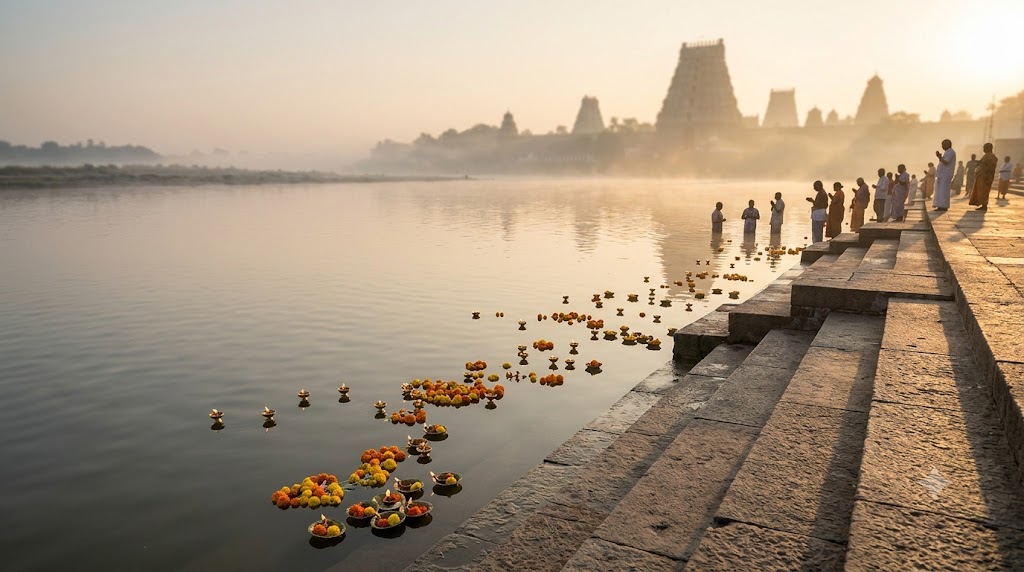
Every 12 years the Godavari’s sacred charge reaches its peak during the Pushkaralu. Tradition holds that the divine Pushkara enters the river when Jupiter, or Brihaspati, moves into Simha Rashi (Leo). Devotees believe a holy dip in this window cleanses the sins of generations.
The next Godavari Pushkaralu falls in 2027, drawing millions to Rajahmundry and the Telangana ghats. Because dates and ghat rotations vary by state and panchangam, confirm the exact window on the official portals before you travel. Our Godavari Pushkaralu 2027 dates and muhurtham guide tracks the current schedule.
Fittingly, the same Jupiter-in-Leo alignment triggers the Simhastha Kumbh at Nashik. So pilgrims honour the river at both ends at once, upstream at its source and downstream in its delta. Few rivers on earth carry that kind of simultaneous reverence.
A brief word of care matters here. Pushkaram crowds are enormous, and river currents can be strong, so old and unwell pilgrims should pick calmer ghats and early hours. For ghat-by-ghat detail, see our Rajahmundry ghats guide and the Telangana ghats guide.
Common Myths About the Southern Ganga, Corrected
Plenty of confusion circulates online about this river. Clearing it up is part of understanding why the title matters so much. Here are the errors worth setting straight.
Myth 1: The Godavari is a branch of the Ganga. It is not. The two rivers never meet, and the Godavari is a wholly separate system. The name marks spiritual equality, not a physical link.
Myth 2: “Dakshina Ganga” is just a modern nickname. Far from it. The Brahma Purana devotes the Gautami Mahatmya to this river, so its sacred name rests on ancient scripture, not tourism.
Myth 3: Only the Godavari is ever called the Southern Ganga. Regionally, the Kaveri is also praised as a “Ganga of the South” in Tamil tradition. Still, the pan-Indian and Puranic title belongs most firmly to the Godavari. Because scripture names it directly, the Godavari’s claim carries the widest acceptance across India.
Before You Go: Why the Title Endures
The Godavari earns the name Dakshina Ganga through a rare blend of scale, scripture, and living devotion. Its Gautama legend, its Ramayana links, and its 12-year Pushkaralu keep the river central to southern faith. If you plan to visit, time your trip around a festival day, choose a ghat that suits your comfort, and read the origin story before you dip. Treat the river with the same respect you would give the northern Ganga, because tradition places them as equals.
Frequently Asked Questions
Why is the Godavari called the Dakshina Ganga?
The Godavari is called the Dakshina Ganga because it holds the same sacred rank in the south that the Ganga holds in the north. Its great length, wide basin, and deep religious importance mirror the northern river. Scripture and pilgrimage tradition both reinforce the title.
Is the Godavari connected to the actual Ganga river?
No, the two rivers are entirely separate systems and never meet. The Godavari rises in Maharashtra, while the Ganga rises in Uttarakhand. “Dakshina Ganga” signals spiritual equality, not a physical connection.
Why is the Godavari also called Gautami Ganga?
The river is called Gautami Ganga because Sage Gautama brought it to earth at Trimbakeshwar, according to the Brahma Purana. He summoned the Ganga to absolve himself of a grave sin. The name honours the sage whose penance created the river.
Where does the Godavari Dakshina Ganga originate?
The Godavari originates at the Brahmagiri Hills in Trimbakeshwar, near Nashik in Maharashtra. From there it flows east for about 1,465 km across the Deccan. Finally it drains into the Bay of Bengal near Rajahmundry.
Which is longer, the Godavari or the Ganga?
The Ganga is longer, at roughly 2,525 km against the Godavari’s 1,465 km. Even so, the Godavari is the longest river in peninsular India. It ranks second in the country only after the Ganga.
Is the Kaveri also called the Dakshina Ganga?
The Kaveri is sometimes praised as a “Ganga of the South” in Tamil tradition. However, the pan-Indian and Puranic title of Dakshina Ganga belongs most firmly to the Godavari. The Godavari’s scriptural links make its claim the strongest.
When is the next Godavari Pushkaralu?
The next Godavari Pushkaralu falls in 2027, when Jupiter enters Simha Rashi. The most sacred period lasts twelve days, with Rajahmundry as the main hub. Confirm exact dates on the official portals, as the window varies by state and panchangam.
What other names does the Godavari have?
Besides Dakshina Ganga, the river is known as Gautami Ganga, Vriddha Ganga, and Goda. Each name carries a piece of its legend. “Vriddha Ganga” means the old Ganga, while “Goda” means the bestower of cows.

Godavari Pushkaralu Editorial is the team that researches, writes and maintains this site.
godavaripushkaralu.org.in is an independent pilgrim guide. It is not affiliated with, endorsed by, or the official website of any government body or temple administration, and it takes no bookings or payments.
How we work: festival dates come from the Andhra Pradesh government notification and the East Godavari district portal rather than from other guides. Jupiter’s transits, which set the twelve-year Pushkaram cycle, are checked against published panchangam transit tables. Claims about government arrangements — ghats, medical camps, transport, helpdesks — are attributed to their source or clearly marked as plans, because for a festival still months away most of them are plans. Volatile details such as fees and muhurtham clock times link out to the official portal instead of being fixed in our pages.
Every page here is re-checked on a fixed schedule and corrected when the facts move. If you find an error, tell us through the contact page and we will fix it.