
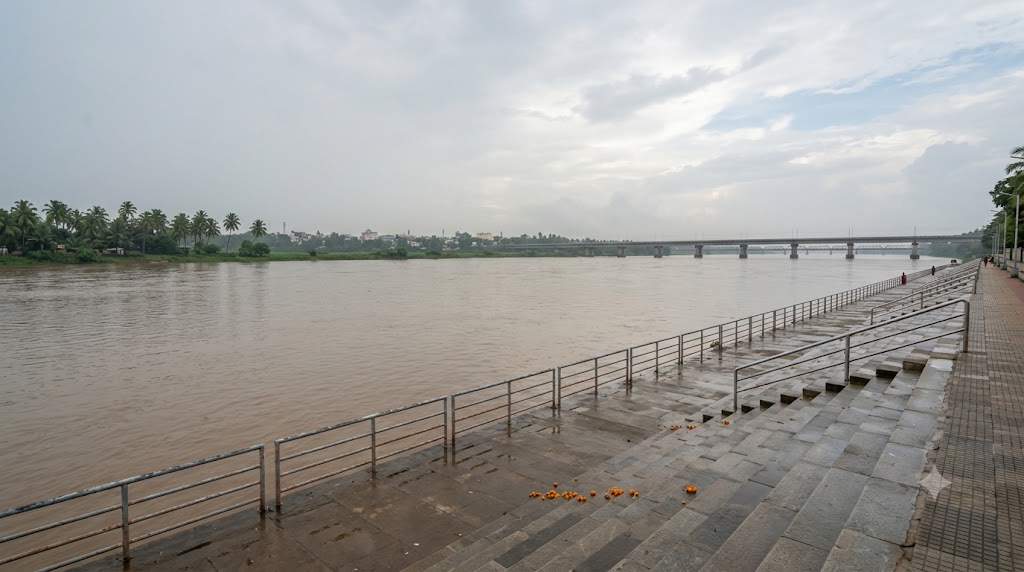
Put Pushkaralu 2015 vs 2027 side by side and the calendar is the first thing that jumps out. The last Godavari Pushkaram ran from 14 to 25 July 2015. Meanwhile, the next one runs from 26 June to 7 July 2027. So it lands nearly three weeks earlier in the year.
That single shift has already broken travel plans across the internet. Dozens of pages still print an older, withdrawn set of dates.
godavaripushkaralu.org.in is an independent pilgrim guide. We are not affiliated with, endorsed by, or the official website of the Andhra Pradesh or Telangana governments, the Endowments Department, or any temple trust. We do not accept bookings, donations, or payments. For reservations and official notifications, please use the official portals linked in this article.
Pushkaralu 2015 vs 2027 at a Glance
- 2015 window: 14–25 July 2015, opening on a Tuesday.
- 2027 window: 26 June to 7 July 2027, so the festival opens on a Saturday.
- Gap between them: 4,365 days, or roughly 11 years and 11.5 months, and therefore not a clean 12 years.
- 2015 status: promoted as a Maha Pushkaram, although several almanac scholars publicly disputed that claim.
- 2027 status: an ordinary 12-year Pushkaram, since no Maha claim attaches to it.
- Biggest planning change: Andhra Pradesh will spread pilgrims across hundreds of numbered ghats instead of funnelling them to one.
The Dates Moved, and the Old Ones Are Still Online
The Endowments Department issued GO Rt No.1575 in December 2025. So the notified window for 2027 is 26 June to 7 July. The schedule then appeared in an Extraordinary Gazette dated 12 December 2025.
Officials set the dates on the advice of Thangirala Venkata Krishna Purna Prasad. He serves as the Asthana Siddhanti of Tirumala Tirupati Devasthanams (TTD).
Before that notification, a different window circulated widely: 23 July to 3 August 2027. Ministers used it in the Assembly in March 2025, and news sites repeated it for months afterwards. Since the gazette replaced it, that window no longer applies. If a page still shows July or August 2027, it predates the notification, so do not plan around it.
A smaller error also floats around. Some reports describe 2027 as a nine-day event closing on 4 July. However, the gazetted window runs twelve days and ends on 7 July 2027. Both festivals in this Pushkaralu 2015 vs 2027 comparison last exactly twelve days, so the duration itself never changed.
Our Pushkaralu 2027 dates and muhurtham calendar tracks the notified schedule day by day, and it updates whenever the state issues a revision.
Was 2015 a Maha Pushkaram, and Is 2027 One Too?
No, 2027 is not a Maha Pushkaram. Organisers promoted the 2015 festival as one, because it marked the twelfth turn of the twelve-year Godavari cycle. Tradition holds that this alignment recurs once in 144 years.
On that reckoning the next Maha Pushkaram falls in 2159. So 2027 is simply the next regular Pushkaram.
That said, the 144-year claim never won universal acceptance. Hanmanthavajjula Subrahmanya Sarma, then president of the State Drukghanitha Almanac Writers’ Association, publicly called the theory a myth while questioning who had calculated it. Several almanac writers agreed with him at the time.
This matters for a practical reason, not a theological one. The Maha label drove much of the 2015 publicity surge, and a later judicial inquiry pointed straight at that surge. Devotees comparing Pushkaralu 2015 vs 2027 often assume 2027 will therefore be quieter. Official projections say the opposite.
Why the 2027 Window Starts 18 Days Earlier
Pushkaram timing follows Brihaspati, the planet Jupiter, as it enters Simha rasi. Jupiter takes a little under twelve years to return to the same sidereal position. So each Godavari Pushkaram drifts earlier in the Gregorian calendar than the one before it.
The arithmetic is easy to check. From 14 July 2015 to 26 June 2027 is 4,365 days, which works out to about 11.95 years. So in calendar terms, the 2027 opening lands 18 days earlier in the year than the 2015 opening did. Clearly, the “once in twelve years” phrase is a convenient round number rather than an exact interval.
One consequence of the Pushkaralu 2015 vs 2027 shift deserves flagging early. The 2015 festival opened on a Tuesday, while 2027 opens on a Saturday. Naturally, a weekend start pulls day-trip crowds from Kakinada, Eluru, Vijayawada, and Visakhapatnam straight into the first-day rush.
Pushkaralu 2015 vs 2027: Crowd Scale Compared
Officials put 2015 attendance across both Telugu states at roughly 11 crore. That split about 6.4 crore in Andhra Pradesh and 4.6 crore in Telangana. The single heaviest day recorded 58.2 lakh holy dips.
Those were the numbers planners worked from afterwards. Any honest Pushkaralu 2015 vs 2027 comparison starts there.
For 2027, Andhra Pradesh alone is planning for up to 10 crore devotees. Government estimates put peak single-day footfall close to 1 crore, which is roughly double the 2015 record. Chief Minister Nara Chandrababu Naidu has repeatedly framed the target as Maha Kumbh scale instead of Pushkaram scale.
Still, treat every one of these figures as a planning estimate. Attendance counts at open river events are approximations, and the 2027 numbers remain projections made eighteen months out. They help you judge direction, though not precision.
What the 2015 Stampede Inquiry Actually Found
On the opening morning of 14 July 2015, a crush at the main Pushkar Ghat in Rajahmundry killed 27 pilgrims. Most were women, while dozens more suffered injuries. It happened between roughly 7.30 am and 8 am, shortly after the first dips. The then East Godavari Collector said the ghat held about 15,000 people while around 50,000 waited outside it.
The Justice C.Y. Somayajulu commission tabled a 17-page report in the Andhra Pradesh Assembly in 2018. It blamed the media, almanac pundits, and religious preachers for a sustained campaign. They insisted that a dip at one precise moment, 6.26 am, carried special merit.
Notably, the commission also found that Rajahmundry dominated the publicity while other ghats went largely unmentioned.
That finding is the single most useful thing in any Pushkaralu 2015 vs 2027 comparison. The 2015 tragedy did not happen because too many pilgrims came. It happened because too many pilgrims went to one place at one minute.
Pushkaralu 2015 vs 2027: Ghats, Spending and Infrastructure
The 2027 design answers that finding directly. Andhra Pradesh has approved work on 525 ghats across six districts, adding 237 new ghats to 288 existing ones. Total ghat frontage will grow from about 4.5 km to about 9.9 km, along a 212 km stretch of the river.
| Measure | 2015 | 2027 (planned) |
|---|---|---|
| Festival window | 14–25 July | 26 June – 7 July |
| Opening day | Tuesday | Saturday |
| Attendance | ~11 crore, both states | Up to 10 crore, AP alone |
| Peak single day | 58.2 lakh dips | ~1 crore projected |
| AP ghat frontage | ~4.5 km | ~9.9 km |
| Crowd control | Police cordons, CCTV | AI monitoring, numbered ghats |
| AP districts | 2 undivided districts | 6 districts |
Money has moved as well. A ₹904 crore proposal covers ghat development. The Centre has already sanctioned ₹100 crore, while the state has earmarked ₹271.43 crore for Rajahmundry railway station. In mid-2026 the government released ₹580 crore for a first phase of permanent works.
Meanwhile, urban and rural departments listed roughly 2,800 works worth around ₹3,080 crore between them.
By comparison, contemporary reporting placed the combined 2015 outlay somewhere between ₹1,500 crore and ₹2,300 crore across both states. Sources disagreed then and still disagree now, so treat that as a range rather than a fixed figure.
Pushkaralu 2015 vs 2027: The Map Itself Has Changed
In 2015 the Andhra side of the festival sat mainly in undivided East Godavari and West Godavari districts. Since then Andhra Pradesh has reorganised, so the same river stretch now runs through six districts. They are Polavaram, Eluru, East Godavari, West Godavari, Dr B.R. Ambedkar Konaseema, and Kakinada.
That is not a cosmetic change. Konaseema alone accounts for a large share of the planned ghats, while the first Pushkar Ghat sits at Gundala in Polavaram district. Downstream, the ghats at Antarvedi, Balusutippa, Govvalanka, and Narasapuram close the chain.
For a pilgrim weighing Pushkaralu 2015 vs 2027, the practical effect is choice. In 2015 the well-known options were Rajahmundry, Kovvur, Dowleswaram, Narasapuram, and Antarvedi. In 2027 there will be several hundred numbered ghats, so the quieter ones become genuinely usable.
Telangana’s Dates Are Not Settled the Same Way
Here is a gap most comparison pages miss. The 26 June notification came from Andhra Pradesh alone. Telangana hosts major bathing sites at Basara, Kaleshwaram, Dharmapuri, Manthani, and Bhadrachalam. When it reviewed preparations in September 2025, officials were still working to a 23 July 2027 start.
Telangana has identified around 74 ghats along roughly 560 km of river inside the state. Meanwhile, a 550 km Basara–Bhadrachalam temple circuit is taking shape. Because the astronomical basis is identical on both banks, the windows should eventually align. Even so, confirm your dates with the Telangana Endowments Department before you book travel to a Telangana ghat.
Pushkaralu 2015 vs 2027: How to Plan Differently
The lesson from 2015 is not to avoid the festival. Instead, it is to avoid the peak.
Skip the opening morning if you can
Tradition attaches merit to the whole twelve-day window, and to the closing days as much as the opening. Because 26 June 2027 falls on a Saturday, the first-day crush will likely exceed 2015’s Tuesday opening. So choose a weekday between 29 June and 2 July instead.
Pick a ghat before you pick a train
Rajahmundry sells out first, so Kovvuru, Kakinada, and Narasapuram work well as backup bases. Book rail and rooms 60 to 90 days ahead. Our Pushkar Ghat accommodation guide covers tent cities as well as homestay options.
Ignore any single “best minute” claim
This follows directly from the Somayajulu findings. If a page or a forwarded message insists on one exact muhurtham at one named ghat, then treat it as a crowd risk rather than guidance.
Book only through official channels
Large festivals attract look-alike portals that copy government branding before collecting advances. Start at the Andhra Pradesh Endowments portals, and never send money to a personal number. The official Pushkaralu safety guidelines explain what the ghats allow.
A Health and Safety Note Worth Reading Twice
Both windows fall inside the southwest monsoon, when the Godavari can run fast and the steps stay slippery. Currents near barrages and confluences are stronger than they look from the bank.
If you have a heart condition, mobility limits, or a pregnancy, speak to your doctor before committing to a long queue. Also carry medication, oral rehydration salts, and a written contact card. Ritual merit is a matter of faith and tradition, so it never substitutes for medical care.
Before You Go
Three things carry over from this Pushkaralu 2015 vs 2027 comparison. First, the dates are 26 June to 7 July 2027, notified by gazette, so any July or August listing is stale. Second, 2027 is a regular Pushkaram rather than a Maha Pushkaram, yet officials still project it far larger than 2015. Third, the state’s whole design answers one 2015 finding: spread the crowd, and stop treating a single minute at a single ghat as the only valid dip.
Plan around a weekday, then choose a ghat close to where you can actually sleep. After that, verify every date and fee on official portals such as the East Godavari district Pushkaralu page or the Andhra Pradesh Endowments Department. Arrangements will keep evolving until the state publishes its final action plan. For a wider view, see our Godavari and Krishna Pushkaralu comparison.
Frequently Asked Questions
What are the confirmed dates for the 2027 Godavari Pushkaralu?
26 June to 7 July 2027, a twelve-day window. Andhra Pradesh notified this through GO Rt No.1575 and an Extraordinary Gazette dated 12 December 2025. Since then, the earlier 23 July to 3 August window no longer applies.
Why do some websites still show July or August 2027?
Because those pages predate December 2025. Ministers cited a July–August window in the Assembly in March 2025, and many sites copied it. So always check whether a page references the gazette notification.
Is the 2027 Pushkaram bigger than 2015?
By official projection, yes. Andhra Pradesh alone expects up to 10 crore devotees, while both states together drew about 11 crore in 2015. Officials also project peak single-day footfall near 1 crore, roughly double the 58.2 lakh recorded in 2015.
What caused the 2015 Rajahmundry stampede?
A crush at the main Pushkar Ghat on 14 July 2015 killed 27 pilgrims. The Justice C.Y. Somayajulu commission blamed publicity that concentrated crowds on one ghat at one advertised muhurtham. Ghat capacity stood near 15,000, while roughly 50,000 people waited outside.
Will 2027 be safer than 2015?
The design intent is clearly safer, although no open-river gathering is risk-free. Andhra Pradesh plans 525 ghats over about 9.9 km, plus numbered entry and exit routes. AI-assisted crowd monitoring and parking away from the ghats are also part of the plan. Still, pilgrim behaviour matters as much as infrastructure.
Is 2027 a Maha Pushkaram?
No, it is not. Organisers applied the Maha label to 2015 as the twelfth turn of the cycle, said to recur once in 144 years. On that reckoning the next falls in 2159, although some almanac scholars disputed the 144-year claim even in 2015.
Are the Telangana dates the same as Andhra Pradesh?
The astronomical basis is identical, so the windows should match. However, Telangana’s publicly reported reviews in 2025 still referenced a 23 July start, and its own notification did not appear alongside the Andhra gazette. Confirm with the Telangana Endowments Department before booking.
Which day is best for a holy dip in 2027?
A weekday in the middle of the window, roughly 29 June to 2 July, balances merit with manageable crowds. Meanwhile, the opening Saturday and the closing day will be the heaviest. Tradition treats the entire twelve-day period as sacred.
How many ghats will there be in 2027?
Andhra Pradesh has approved 525 ghats across six districts, combining 288 existing ghats with 237 new ones. Telangana has identified around 74 ghats along its 560 km stretch. Final counts may still shift while construction progresses.
Can I plan 2027 using what happened in 2015?
Only partly, because a Pushkaralu 2015 vs 2027 comparison shows how much has changed. The dates, the district map, the ghat count, and the crowd-control approach are all different. Use 2015 for realistic crowd expectations, though never for logistics.

Godavari Pushkaralu Editorial is the team that researches, writes and maintains this site.
godavaripushkaralu.org.in is an independent pilgrim guide. It is not affiliated with, endorsed by, or the official website of any government body or temple administration, and it takes no bookings or payments.
How we work: festival dates come from the Andhra Pradesh government notification and the East Godavari district portal rather than from other guides. Jupiter’s transits, which set the twelve-year Pushkaram cycle, are checked against published panchangam transit tables. Claims about government arrangements — ghats, medical camps, transport, helpdesks — are attributed to their source or clearly marked as plans, because for a festival still months away most of them are plans. Volatile details such as fees and muhurtham clock times link out to the official portal instead of being fixed in our pages.
Every page here is re-checked on a fixed schedule and corrected when the facts move. If you find an error, tell us through the contact page and we will fix it.