Godavari Pushkaralu history reaches back much further than the 2015 photographs most people remember. Because the festival returns only once every twelve years, each generation learns it afresh, and errors travel faster than corrections. This guide follows the whole arc, from the Puranic legend of Pushkara to the gazetted 2027 dates.
godavaripushkaralu.org.in is an independent pilgrim guide. We are not affiliated with or endorsed by the Government of Andhra Pradesh, the Endowments Department, or any temple trust. We accept no bookings, donations, or payments, so please use the official portals linked below for all arrangements.
Godavari Pushkaralu History at a Glance
Here is the short version, before the detail. The sections below expand each point in turn.
- The legend: Pushkara, son of Varuna in tradition, won boons from Brahma and Shiva to sanctify rivers.
- The clock: the festival tracks Brihaspati (Jupiter). Godavari’s turn arrives when Jupiter enters Simha rashi (Leo).
- The rhythm: twelve rivers and twelve zodiac signs, so each river gets its Pushkaram once in twelve years.
- Recent editions: 1979, 1991, 2003 and 2015, with Rajahmundry as the busiest centre each time.
- The 2027 dates: 26 June to 7 July 2027, notified by government order and printed in the Extraordinary Gazette.
- Two myths to drop: almanac scholars dispute the “144-year” label on 2015, and the old July–August 2027 dates are outdated.
Where Godavari Pushkaralu History Begins: The Pushkara Legend
The festival takes its name from Pushkara. Puranic and astrological literature describe him as the guardian of sacred waters, and as the son of Varuna, the deity of rain and rivers.
After long penance he won a boon from Brahma. It let him dwell in the water of Brahma’s kamandalu, the sacred vessel. Shiva later granted a second boon, mastery over the water element itself.
Those two boons made Pushkara the Theerthapalaka, or keeper of all sacred waters. Sanskrit commentators read the name from push, meaning nourishment, so Pushkara becomes “the one who nourishes”. The name therefore carries the whole idea of the festival in a single word.
The second version most articles leave out
There is a competing origin story, and it is worth knowing because it shifts the emphasis. The Jataka Parijata, a fourteenth-century astrological treatise, describes a brahmin named Tundila who performed severe penance to Shiva. Shiva granted him the power to live within water and to purify rivers, after which he became known as Pushkara.
Both accounts end at the same place. Each makes Pushkara a sanctifying presence rather than a river deity in his own right. Most online summaries pick one version and present it as the only one, so knowing that two traditions exist is a small marker of Godavari Pushkaralu history done properly.
Why Jupiter Sets the Calendar
Brihaspati, the planet Jupiter, takes roughly twelve years to travel the zodiac. It spends about a year in each sign, so a full circuit matches the twelve-year festival cycle almost exactly. Tradition holds that Pushkara accompanies Jupiter into each new sign and enters the river assigned to it.
Tradition pairs Godavari with Simha rashi, the sign of Leo. When Jupiter enters Simha, the Godavari Pushkaralu begins. That astronomical rule forms the spine of Godavari Pushkaralu history, because nobody can move the dates for convenience. Siddhantis calculate them, not administrators.
Adi Pushkaram and Antya Pushkaram
Jupiter stays in a sign for about twelve months, yet the festival itself runs for twelve days. The first twelve days after entry carry the name Adi Pushkaram, and these draw the crowds. The final twelve days before Jupiter leaves the sign carry the name Antya Pushkaram, and they offer similar merit with a fraction of the rush.
The twelve rivers and their signs
- Mesha (Aries) — Ganga.
- Vrishabha (Taurus) — Narmada.
- Mithuna (Gemini) — Saraswati.
- Karkataka (Cancer) — Yamuna.
- Simha (Leo) — Godavari.
- Kanya (Virgo) — Krishna.
- Tula (Libra) — Kaveri.
- Vrischika (Scorpio) — Tamraparni.
- Dhanu (Sagittarius) — Brahmaputra.
- Makara (Capricorn) — Tungabhadra.
- Kumbha (Aquarius) — Sindhu.
- Meena (Pisces) — Pranahita.
Regional traditions vary on a few pairings, particularly for Tamraparni, Bhima and Brahmaputra. The Godavari–Simha link, however, holds across every school.
The River’s Own Story: Gautami and the Dakshin Ganga
You cannot separate Godavari Pushkaralu history from the river’s own origin legend. The Godavari rises at Brahmagiri near Trimbakeshwar in Nashik district, Maharashtra. From there she runs about 1,465 km to the Bay of Bengal, which makes her India’s second-longest river and earns the name Dakshin Ganga.
The Kotirudra Samhita of the Shiva Purana tells the story of Sage Gautama. During a long drought he obtained everlasting water from Varuna by digging a pit. A cow later died in his field, and believing he had incurred the sin of gohatya, he sought Shiva’s help.
Shiva released Ganga onto the earth at Brahmagiri, and she flowed as the river we now call Godavari. Because the river came through Gautama’s penance, scripture also names her Gautami. The Brahma Purana devotes a whole section, the Gautami Mahatmya, to the sacred sites along her banks across 105 chapters.
Rajahmundry’s Place in Godavari Pushkaralu History
Rajamahendravaram, still widely called Rajahmundry, anchors most of Godavari Pushkaralu history for practical reasons as much as sacred ones. The river runs broad and steady here before it splits into the delta. The town has also served as a Telugu cultural capital for roughly a thousand years, and that gave it the temples, priests and infrastructure a mass pilgrimage needs.
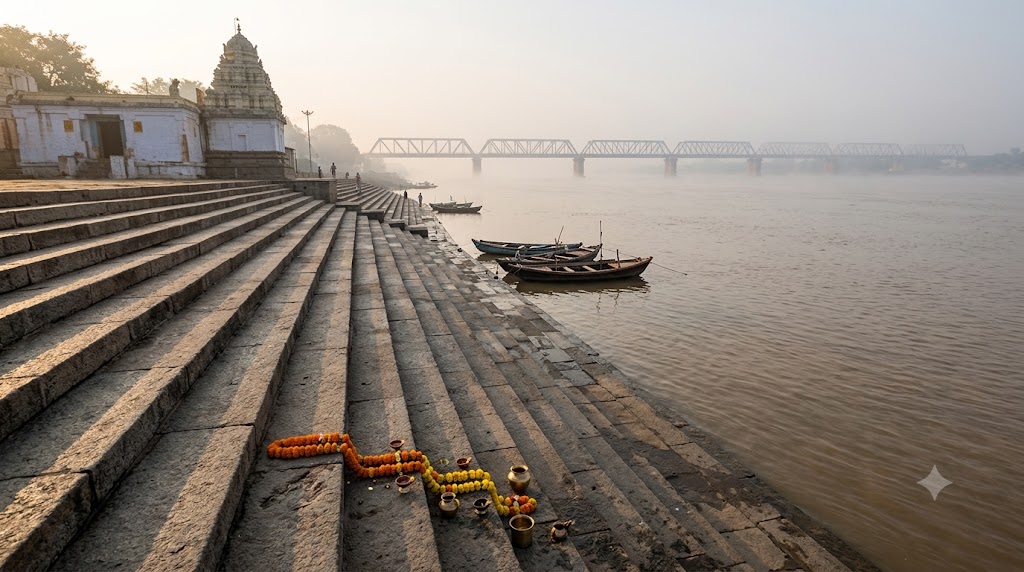
Four ghats carry distinct roles that repeat each cycle. Pushkar Ghat handles the main holy dip. Kotilingala Ghat serves Shiva worship, Gowthami Ghat hosts ancestral rites, and Saraswati Ghat is where children begin their letters.
Yet the festival was never confined to one town. Basara, Dharmapuri, Kaleshwaram and Bhadrachalam in Telangana have drawn pilgrims for generations. So have Pattiseema, Kovvur, Narasapuram and Antarvedi downstream, and you can see the full spread on our Pushkar locations guide.
Godavari Pushkaralu History in the Modern Era
Written records of individual editions get thin before the twentieth century, since Pushkarams were community events rather than state-managed ones. Godavari Pushkaralu history becomes far easier to document from 1979 onward. Government organisation, published budgets and temporary infrastructure took shape steadily across those cycles.
| Year | What marked it |
|---|---|
| 1979 | Held in undivided Andhra Pradesh, with astrologers publicly debating the exact hour of Jupiter’s entry into Simha. |
| 1991 | Passed off smoothly, and is generally cited as the point where administrative planning matured. |
| 2003 | The last edition before the state split, drawing heavy crowds to Rajahmundry through late July. |
| 2015 | The first Pushkaram run by two states, and by far the largest on record. |
| 2027 | Scheduled for 26 June to 7 July, with the Prayagraj Maha Kumbh cited as the management model. |
What Really Happened in 2015
The 2015 festival ran from 14 to 25 July and reset every expectation. Godavari Pushkaralu history records it as the largest edition yet. Official figures put attendance at about 4.81 crore in Andhra Pradesh and 5.7 crore in Telangana, so the combined count crossed 11 crore.
Andhra Pradesh alone spent close to ₹1,295 crore on infrastructure. Yet the festival began in tragedy. On the opening morning a stampede at Pushkar Ghat killed at least 27 pilgrims, most of them women, and dozens more suffered injuries. Later accounts placed the toll as high as 29.
The cause was straightforward and preventable. The district collector put the ghat’s capacity at around 15,000, while roughly 50,000 people had gathered outside it. Publicity had concentrated on one ghat and left others comparatively empty, so the crowd funnelled into a single gate.
Was 2015 really a “Maha Pushkaralu”?
This is the biggest myth still in circulation, and it deserves a direct answer. Promoters billed 2015 everywhere as a Maha Pushkaralu that arrives only once in 144 years. The reasoning ran that 2015 completed the twelfth repetition of the twelve-year cycle. Several almanac scholars rejected that reasoning at the time.
Hanmanthavajjula Subrahmanya Sarma then headed the State Drukghanitha Almanac Writers’ Association. He told Deccan Chronicle in July 2014 that the 144-year theory was a myth. Nobody, he said, could explain who had calculated it or how.
The claim has no clear scriptural anchor. Treat it as a modern promotional label rather than settled tradition. That distinction matters whenever you read older writing on Godavari Pushkaralu history.
The 2027 Dates, and the Error Still Being Repeated
Godavari Pushkaralu 2027 runs from 26 June to 7 July 2027. The Andhra Pradesh government issued Government Order Rt No 1575 in December 2025 and directed that the schedule appear in the Extraordinary Gazette dated 12 December 2025. The dates follow calculations by Thangirala Venkata Krishna Purna Prasad, the Asthana Siddhanti of Tirumala Tirupati Devasthanams.
Plenty of pages still show 23 July to 3 August 2027. That range came from statements in the state assembly during early 2025, before siddhantis finalised the astronomical calculation. It never reached the gazette, so treat any page still carrying it as out of date. The notification closed a genuinely confusing chapter in recent Godavari Pushkaralu history.
Check the daily schedule on our dates and muhurtham page. Then confirm against the district administration’s own Godavari Pushkaralu 2027 page before you book travel.
What 2027 Will Add to the Record
Preparations already dwarf 2015. Andhra Pradesh expects around 10 crore devotees, and officials estimate that single-day peaks could touch one crore. For comparison, the busiest single day in 2015 saw about 58.2 lakh dips.
The building programme is correspondingly large. The Municipal Administration and Urban Development department has taken up roughly 1,660 works worth close to ₹2,000 crore. The Panchayat Raj department is handling about 1,140 works valued near ₹1,080 crore. Telangana’s endowments department has separately proposed around ₹530 crore for ghats at Basara, Dharmapuri, Kaleshwaram and Bhadrachalam.
One idea may outlast the festival itself. The state has proposed an “Akhanda Godavari Corridor” between Dhavaleswaram and the Polavaram project. Officials want everything built for 2027 to remain a permanent regional asset.
These are proposals and allocations reported through 2026, not final spending. Verify current numbers on the AP Endowments portal nearer the date.
What Most Pilgrims Get Wrong
Godavari Pushkaralu history passes down largely by memory, so the same errors repeat every cycle. Four surface constantly, and each one costs pilgrims time or comfort.
- “The first dip is the only one that counts.” Tradition ascribes merit to the entire twelve-day window. The opening morning is simply the most dangerous time to stand at a ghat.
- “Rajahmundry is the only real place.” Antarvedi, where the Vasishta Godavari meets the sea, carries particular weight for ancestral rites. Kovvur sits directly across the river and absorbs overflow.
- “Pushkaralu lasts a year.” Jupiter’s transit lasts about a year, but the observed festival runs twelve days.
- “2015 was a once-in-144-years event.” As above, almanac scholars contest that label.
A note on safety. Ghat steps get slippery, and monsoon currents run strong in late June. Queues can also mean hours on your feet in humid heat.
Pilgrims, pregnant women, and anyone with heart or mobility conditions should plan a quieter day. Consult a doctor before travelling, and read the official Pushkaralu guidelines before you go.
Before You Go
The thread running through Godavari Pushkaralu history is continuity rather than spectacle. A Puranic legend, a planetary cycle and an ancient river converge for twelve days in 2027. The crowds and budgets are new, yet the reason for the dip has not changed since the Brahma Purana described these banks.
Two practical takeaways. Fix your travel around 26 June to 7 July 2027, and ignore any page still printing the old July–August range. Then pick a day other than the opening morning, because in 2015 everyone chose the same hour at the same gate.
Frequently Asked Questions
How old is the Godavari Pushkaralu tradition?
Nobody can verify a founding date, so Godavari Pushkaralu history has no fixed starting year. The legend of Pushkara appears in Puranic literature and in astrological treatises such as the fourteenth-century Jataka Parijata. Tradition treats the observance as ancient, though detailed records of individual festivals appear only in the modern era.
Why is Godavari Pushkaralu held every 12 years?
Because Jupiter takes about twelve years to complete one circuit of the zodiac. Tradition links each of the twelve sacred rivers to one sign, and a river’s Pushkaram begins when Jupiter enters it. Godavari’s sign is Simha, so its turn comes once every twelve years.
When exactly is Godavari Pushkaralu 2027?
From 26 June to 7 July 2027. Government order notified this twelve-day window, and the Extraordinary Gazette of 12 December 2025 published it. Rajamahendravaram remains the principal centre, with major ghats also active in Telangana and across the delta.
Was the 2015 Godavari Pushkaram a Maha Pushkaram?
Organisers promoted it as one, on the basis that it completed the twelfth cycle of twelve years. Several almanac scholars publicly disputed the 144-year figure, since its origin and method of calculation were never established. Devotees may follow either view, though the claim is not settled fact.
What happened at Rajahmundry in 2015?
A stampede at Pushkar Ghat on the opening morning of 14 July 2015 killed at least 27 pilgrims. Later accounts cite up to 29. Officials said the ghat could hold around 15,000 people, while roughly 50,000 had gathered outside. Crowd distribution across multiple ghats now sits at the centre of planning for 2027.
When was the previous Godavari Pushkaralu before 2027?
In 2015, from 14 to 25 July. Earlier modern editions fell in 2003, 1991 and 1979. Following the same cycle, the Pushkaralu after 2027 falls due in 2039.
What is the difference between Adi Pushkaram and Antya Pushkaram?
Adi Pushkaram covers the first twelve days after Jupiter enters the sign, and this is the main festival period. Antya Pushkaram covers the final twelve days before Jupiter leaves that sign, roughly a year later. Tradition treats both as sacred, though Adi Pushkaram draws far larger crowds.
Why is the Godavari called Gautami?
The name honours Sage Gautama, whose penance brought the river to earth according to the Shiva Purana. The Brahma Purana’s Gautami Mahatmya uses the name throughout its account of the river’s sacred sites. Locally, the eastern branch of the delta still carries the name Gautami Godavari.

Godavari Pushkaralu Editorial is the team that researches, writes and maintains this site.
godavaripushkaralu.org.in is an independent pilgrim guide. It is not affiliated with, endorsed by, or the official website of any government body or temple administration, and it takes no bookings or payments.
How we work: festival dates come from the Andhra Pradesh government notification and the East Godavari district portal rather than from other guides. Jupiter’s transits, which set the twelve-year Pushkaram cycle, are checked against published panchangam transit tables. Claims about government arrangements — ghats, medical camps, transport, helpdesks — are attributed to their source or clearly marked as plans, because for a festival still months away most of them are plans. Volatile details such as fees and muhurtham clock times link out to the official portal instead of being fixed in our pages.
Every page here is re-checked on a fixed schedule and corrected when the facts move. If you find an error, tell us through the contact page and we will fix it.