The Pushkaram vs Kumbh Mela question trips up even lifelong devotees. Both are twelve-year river gatherings built around a single holy dip, so people often assume they are the same festival. They are not.
One honours a river when Jupiter enters its zodiac sign. The other rotates between four fixed cities on a rarer planetary alignment. This guide settles the confusion clearly, because getting it right changes how, when and where you plan your pilgrimage.
Pushkaram vs Kumbh Mela at a Glance
Here is the short Pushkaram vs Kumbh Mela answer before the detail. A Pushkaram is a river festival tied to one planet. The Kumbh Mela is a four-city festival tied to a planetary combination.
- Trigger: Pushkaram starts when Jupiter alone enters a river’s zodiac sign; Kumbh needs Jupiter, the Sun and the Moon in set positions.
- Locations: Pushkaram rotates among 12 sacred rivers; Kumbh rotates among just 4 cities.
- Core ritual: Pushkaram leans heavily on ancestor rites; Kumbh is famous for the Akhara processions and royal bath.
- Duration: A Pushkaram peaks over 12 days; a Kumbh can run for weeks or even months.
- Scale: The 2025 Prayagraj Maha Kumbh drew record crowds; a big Pushkaram draws tens of millions.
What Is a Pushkaram?
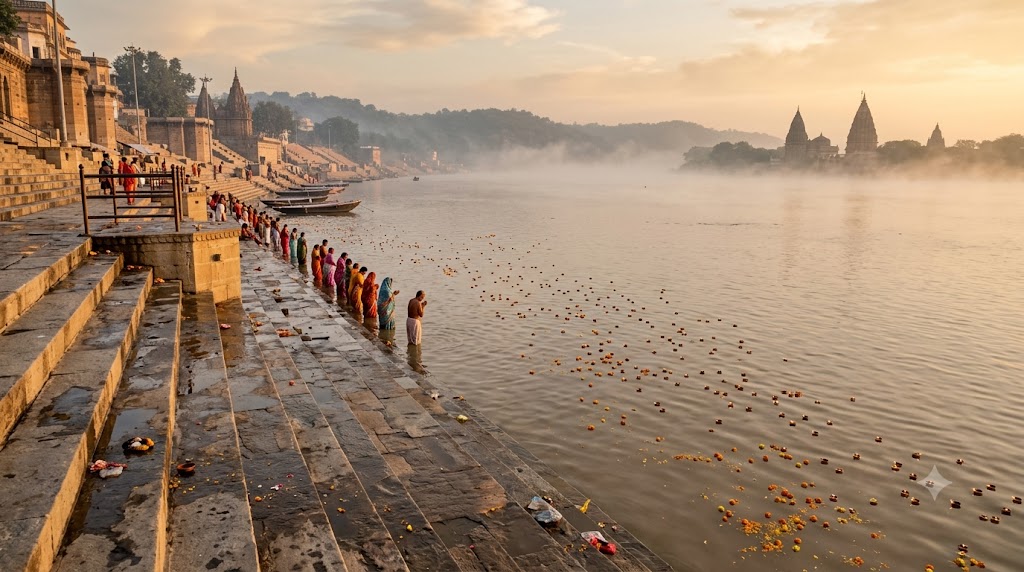
A Pushkaram is a twelve-day Hindu festival that honours one sacred river when Jupiter enters the zodiac sign linked to it. Devotees believe a divine being named Pushkara enters the water for those days. A dip is said to cleanse sins and bless ancestors. Each of India’s twelve major rivers takes its turn as Jupiter moves through the zodiac.
The legend comes from medieval astrology, not the early Vedas. According to the Jataka Parijata, a treatise from around 1426 CE, a Brahmin won a boon to purify rivers. He became Pushkara, meaning “the one who nourishes.” Since Jupiter takes about twelve years to circle the zodiac, each river’s Pushkaram returns once every twelve years.
The rituals centre on the family and the departed. Pilgrims perform snanam, the holy dip, then pitru tarpanam, the water offering to ancestors. Many also do pinda pradanam and dana, or charity. Because the Godavari is linked to Simha, or Leo, its Pushkaralu begins the moment Jupiter enters that sign.
What Is the Kumbh Mela?
The Kumbh Mela is a Hindu bathing festival held at four fixed cities when Jupiter, the Sun and the Moon reach set zodiac positions. Those cities are Prayagraj, Haridwar, Nashik and Ujjain. Pilgrims gather to bathe where, by legend, drops of amrita fell to earth. A dip here is believed to wash away lifetimes of karma.
The story traces to the Samudra Manthan, the churning of the cosmic ocean. While gods and demons fought over the nectar of immortality, drops spilled at these four spots. Each city is therefore treated as sacred ground. The festival’s timing depends on a planetary combination, not on Jupiter alone.
The Kumbh is also defined by its holy men. Ascetic orders called Akharas lead grand processions, and the ash-smeared Naga sadhus bathe first on the main days. That royal bath is the Shahi Snan, now often called the Amrit Snan. The name “Kumbh Mela” itself is fairly modern, appearing mainly from the 19th century.
Pushkaram vs Kumbh Mela: The Core Differences
The clearest way to see the Pushkaram vs Kumbh Mela split is side by side. The table below sets out the eight differences that matter most when you plan a trip.
| Feature | Pushkaram | Kumbh Mela |
|---|---|---|
| Astrological trigger | Jupiter enters a river’s sign | Jupiter, Sun and Moon combine |
| Number of sites | 12 sacred rivers | 4 cities |
| Focus | River worship and ancestor rites | Amrita legend and Akharas |
| Peak duration | 12 days | Weeks to months |
| Origin text | Jataka Parijata (1426 CE) | Samudra Manthan myth |
| Holy men | Priests and gotra pandits | Naga sadhus and Akharas |
| Recurrence | Every 12 years per river | Every 12 years per city |
| Typical crowd | Tens of millions | Up to hundreds of millions |
So the two festivals share a twelve-year rhythm, yet almost everything else differs. To make each contrast concrete, the sections below unpack the four biggest ones.
How the Astrological Timing Differs
The single largest difference in the Pushkaram vs Kumbh Mela split is the sky. A Pushkaram begins when Jupiter alone enters a specific rashi, or zodiac sign. Nothing else is required. Since Jupiter stays about a year in each sign, the first twelve days of that entry become the main festival.
The Kumbh needs more. Its dates depend on a combination of Jupiter, the Sun and the Moon, known as Kumbh Yoga. Because three bodies must align, the maths is far more complex.
For example, the Prayagraj Kumbh needs Jupiter in Taurus or Aries while the Sun sits in Capricorn. You can cross-check any Jupiter transit on Drik Panchang. That is why exact dates shift, and why priests confirm them close to the event.
How Many Places Host Each Festival
Geography splits the two apart just as sharply. A Pushkaram can happen almost anywhere across India, because twelve rivers each carry one. When Jupiter moves signs, the festival jumps to the next river in the cycle. The Ganga, Yamuna, Godavari, Krishna, Narmada, Kaveri and others all take a turn.
The Kumbh never moves beyond its four cities. Prayagraj, Haridwar, Nashik and Ujjain hold it in rotation, and no fifth city can join. So a Pushkaram is spread wide across the country, while the Kumbh stays anchored to four riverbanks. This is a key point many pilgrims miss when they compare the two.
The Rituals: Pitru Tarpanam vs Shahi Snan
What people actually do at each event also differs. At a Pushkaram, the ancestors come first. Families gather to perform pitru tarpanam and pinda pradanam, rites that honour departed elders. The gotra-based mantras usually need an accredited priest, so many book one in advance.
At the Kumbh, the spectacle belongs to the Akharas. Their monks process to the river before dawn, and the Naga sadhus lead the Shahi Snan. Ordinary pilgrims bathe around these processions. Both festivals share the holy dip, yet the Pushkaram feels like a family duty while the Kumbh feels like a vast spiritual carnival.
Scale and Crowds: Which Is Bigger?
Raw numbers favour the Kumbh, though not by as much as headlines suggest. The 2025 Prayagraj Maha Kumbh drew more than 660 million pilgrims over its run. Officials called it the largest human gathering ever recorded. That figure, however, covered a rare 144-year event, not a normal Kumbh.
A big Pushkaram is no small affair either. The Godavari Pushkaralu of 2015 pulled tens of millions to the ghats over twelve days. For 2027, planners expect close to eight crore devotees. So while the Kumbh wins on peak scale, both events strain any city that hosts them.
The Godavari Connection: Where Pushkaram vs Kumbh Mela Overlap
Here is the detail almost no comparison mentions, and it matters most on this river. The Godavari is the one place where the Pushkaram vs Kumbh Mela story overlaps. The same planet, Jupiter in Simha, or Leo, triggers both the Godavari Pushkaralu and the Nashik Simhastha Kumbh.
The link is even tighter than the calendar. The Godavari rises at Trimbakeshwar, near Nashik, where the Kumbh’s Shaiva monks bathe at Kushavarta Kund.
The same river then flows south for about 1,465 kilometres. Devotees call her Dakshina Ganga, the Ganga of the South. Far downstream, in Andhra Pradesh, her Pushkaralu unfolds at Rajamahendravaram.
Because both depend on Jupiter entering Leo, both fall in 2027. The Nashik Kumbh’s royal baths land on 2 August, 31 August and 11–12 September 2027, as tracked by Maharashtra Tourism. The Godavari Pushkaralu runs earlier, from 26 June to 7 July 2027, on the official Andhra Pradesh government dates.
So one river hosts a Kumbh at its source and a Pushkaram along its lower course in a single year. If you want to see both, read our Godavari Pushkaralu 2027 guide for the ghat rotation and bathing muhurtham.
Common Myths About Pushkaram vs Kumbh Mela
Several errors spread widely online, so the Pushkaram vs Kumbh Mela debate needs a myth check. Correcting these saves you real money and travel headaches.
Myth 1: They Are the Same Festival
They are not. A Pushkaram worships one river on a single-planet trigger. The Kumbh marks the amrita legend at four cities on a three-body alignment. Sharing a twelve-year cycle does not make them one event.
Myth 2: Every Kumbh Is a “Maha Kumbh”
Most are not. A normal Purna Kumbh happens every twelve years at each city. An Ardh Kumbh falls every six years at Prayagraj and Haridwar.
The rare Maha Kumbh, tied to the 144-year claim, applies only to Prayagraj. Calling every Kumbh a Maha Kumbh is simply wrong.
Myth 3: The 2027 Godavari Dates Are July 23 to August 3
That window is outdated. It was an early provisional date announced in 2025, later revised. The Andhra Pradesh government has since fixed 26 June to 7 July 2027. Always trust the district portal, and recheck before you book travel.
Which Should You Attend?
The Pushkaram vs Kumbh Mela choice depends on what you seek. Pick a Pushkaram if ancestor rites and a specific river matter to your family. It is shorter, more focused and easier to plan around twelve set days. The Godavari edition in 2027 suits Telugu families especially.
Choose the Kumbh if you want the sheer scale and the Akhara spectacle. You will see Naga sadhus, vast tent cities and processions found nowhere else.
If you cannot decide, 2027 gifts you both on the same river. You could bathe at Nashik in the Kumbh and at Rajamahendravaram in the Pushkaram. For the sister comparison, see how the Godavari and Krishna Pushkaralu line up too.
What First-Time Pilgrims Get Wrong
A few practical lessons come only from experience on the ghats. Keep these in mind before you travel.
- Book the priest early. Gotra-based tarpanam needs an accredited pandit, and they fill up fast during peak days.
- Avoid the very first bathing hour. Crowds surge at the Brahma Muhurtam peak, so a mid-morning dip is often safer.
- Confirm dates on official portals. Provisional windows circulate for months before the real ones lock in.
- Plan stays six months out. Hotel rates near any Kumbh or Pushkaram ghat can climb sharply as the dates near.
- Carry offline notes. Mobile networks buckle under crowd load, so save your accommodation address and contacts.
Since both festivals run alongside boat cruises and temple circuits, build a buffer day. A relaxed Papikondalu boat trip pairs well with a Godavari pilgrimage once the main rites are done.
Before You Plan Your Holy Dip
The Pushkaram vs Kumbh Mela difference comes down to three things: the trigger, the sites and the focus. Pushkaram follows Jupiter alone across twelve rivers, with ancestors at its heart.
The Kumbh follows a planetary combination across four cities, with the Akharas at its centre. On the Godavari, uniquely, both align in 2027. Verify every date on an official source, book early, and let faith guide the rest.
Frequently Asked Questions
Is Pushkaram the same as Kumbh Mela?
No, they are different festivals. A Pushkaram honours one river when Jupiter enters its zodiac sign, across twelve rivers in turn. The Kumbh Mela marks the amrita legend at four fixed cities on a Jupiter, Sun and Moon alignment. They only share a twelve-year rhythm.
Why do both the Godavari Pushkaram and the Nashik Kumbh happen in 2027?
Both are triggered by Jupiter entering Leo, or Simha rashi. The Godavari Pushkaralu links to this sign, and the Nashik Simhastha Kumbh uses the same alignment. So both fall on the Godavari river in 2027, at opposite ends of its course.
Which is bigger, a Pushkaram or the Kumbh Mela?
The Kumbh usually draws larger peak crowds. The 2025 Prayagraj Maha Kumbh recorded over 660 million pilgrims. A major Pushkaram still draws tens of millions, and the Godavari 2027 edition expects around eight crore devotees.
How often does each festival occur?
Each recurs every twelve years. A given river’s Pushkaram returns once Jupiter completes its zodiac circle. Each Kumbh city hosts once every twelve years, with an Ardh Kumbh every six years at Prayagraj and Haridwar.
What are the main Godavari Pushkaralu 2027 dates?
The Andhra Pradesh government has fixed 26 June to 7 July 2027 as the twelve-day window. An older provisional window of 23 July to 3 August was later revised. Always confirm on the official district portal before booking.
What is a Shahi Snan?
Shahi Snan means “royal bath,” now often called Amrit Snan. On these key days, the Akharas and their Naga sadhus lead processions and bathe first. It is the highlight of any Kumbh Mela and draws the largest single-day crowds.
Do I need to register or pay to attend?
General entry to both festivals is free and open to all pilgrims. You do not need a pass to take the holy dip. However, you should book accommodation and any priest for ancestor rites well in advance.
Can I attend both a Pushkaram and a Kumbh in 2027?
Yes, and the Godavari makes it easy. The Pushkaralu runs 26 June to 7 July 2027 in Andhra Pradesh. The Nashik Kumbh’s royal baths follow in August and September 2027 in Maharashtra, on the same river.

Godavari Pushkaralu Editorial is the team that researches, writes and maintains this site.
godavaripushkaralu.org.in is an independent pilgrim guide. It is not affiliated with, endorsed by, or the official website of any government body or temple administration, and it takes no bookings or payments.
How we work: festival dates come from the Andhra Pradesh government notification and the East Godavari district portal rather than from other guides. Jupiter’s transits, which set the twelve-year Pushkaram cycle, are checked against published panchangam transit tables. Claims about government arrangements — ghats, medical camps, transport, helpdesks — are attributed to their source or clearly marked as plans, because for a festival still months away most of them are plans. Volatile details such as fees and muhurtham clock times link out to the official portal instead of being fixed in our pages.
Every page here is re-checked on a fixed schedule and corrected when the facts move. If you find an error, tell us through the contact page and we will fix it.